Two wines, five glasses and a measuring tool can turn an abstract idea about blending into a useful question: what changes when you alter the proportion, and which version do you prefer? Keep the total volume equal, retain each wine on its own as a baseline, and write your impressions before looking at the ratios.
This is an immediate tasting exercise with two sound, commercially finished wines. It does not involve fermentation, additives or repairing a faulty bottle, and it tells you nothing about how a mixture will keep or age. The worksheet below is an original desk exercise with checked arithmetic; we have not tested it with wine.
What you are borrowing from a winery
Winemakers compare possible blends against a reference. In its account of the 2022 Monte Bello assemblage, Ridge describes blind comparisons with a control blend. That offers a useful principle: keep something unchanged against which to judge a change.
Iowa State University Extension’s bench-trial guidance describes testing changes on small samples before treating a larger batch. It is winery guidance that includes specialist analytical work. Neither source validates this home adaptation. Here we borrow only measured comparison, using finished wine as both components. Our winemaking guide puts professional blending in its broader production context.
Identify A and B before pouring
Choose two still wines that are sound when opened, preferably of the same colour and a broadly comparable style. That keeps the first question manageable. Avoid a treasured old bottle: sediment, scarcity and the pressure to like it make poor teaching aids. If either wine seems faulty, stop this exercise rather than hoping the other wine will conceal it.
Give the bottles the letters A and B. Copy producer, wine or cuvée, vintage or non-vintage status, region and bottle size from each actual label. Note when each was opened and the serving conditions. “Cabernet” and “the softer one” are not identities you can reconstruct later.
Smell each wine separately and, if you choose to taste, make a short baseline note. Use the same questions for both: aroma, perceived acidity, drying sensation, body and finish. The tasting-notes guide can help you describe one clear observation without chasing a long list of flavours.
Measure five equal samples
Use clean, food-safe measuring tools with markings fine enough for the chosen volumes, five clean similar glasses, a clean mixing vessel if needed, water, paper and a spittoon or discard container. Separate tools for A and B reduce carry-over; otherwise clean and drain thoroughly between components. Do not return measured or tasted wine to either bottle.
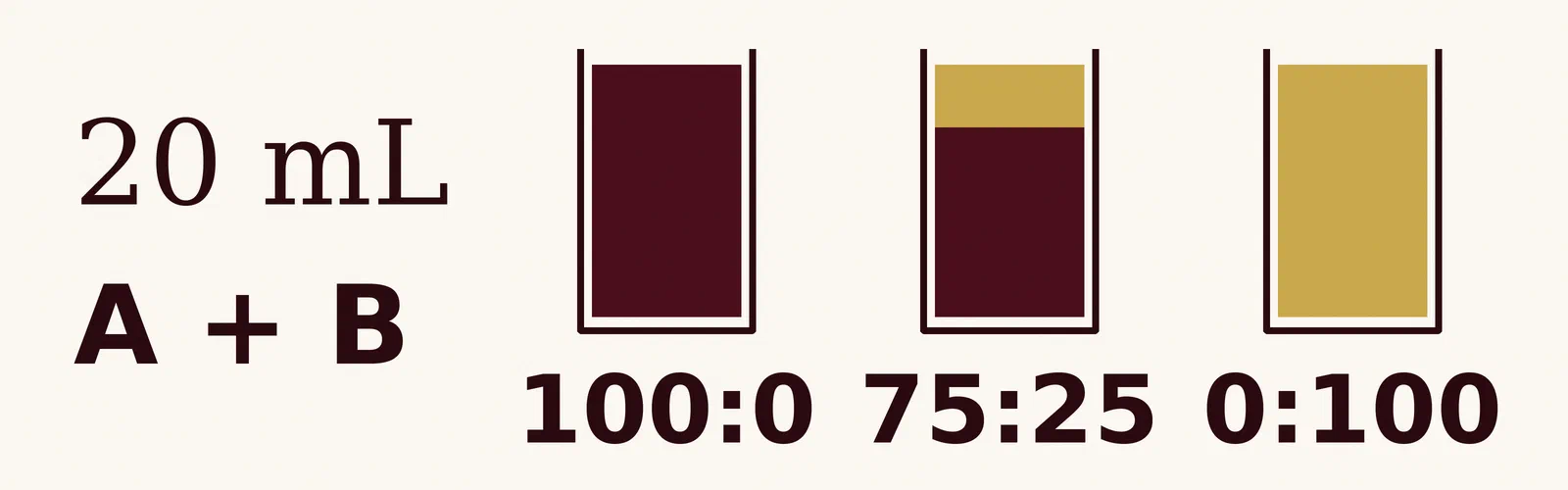
The example uses 20 mL per glass for sample preparation, not as a target to consume. The stacked colours in the illustration represent measured component volumes. You may smell only, spit, stop early or skip the exercise. Arrange transport that does not require driving if tasting alcohol.
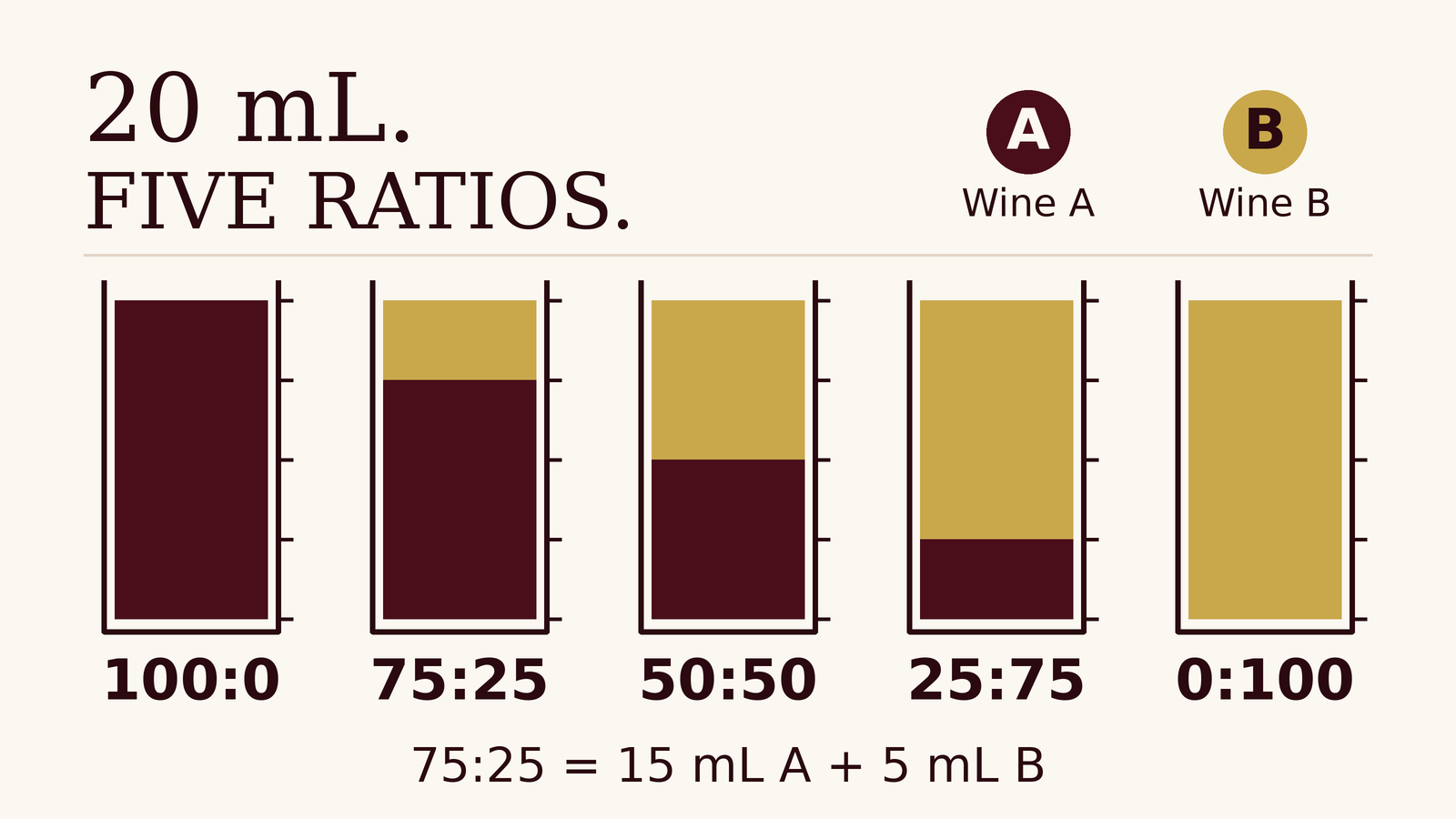
| A:B ratio | A, mL | B, mL |
|---|---|---|
| 100:0 | 20 | 0 |
| 75:25 | 15 | 5 |
| 50:50 | 10 | 10 |
| 25:75 | 5 | 15 |
| 0:100 | 0 | 20 |
Each row totals 20 mL. Preparing the complete set requires 50 mL of A and 50 mL of B, excluding baseline samples, spills or repeats. Measure each glass independently rather than topping up the previous mixture. Gently mix each combined sample consistently.
For another final volume, calculate A volume = final volume × A percentage ÷ 100, then B volume = final volume minus A volume. At 20 mL and 75% A, that is 20 × 75 ÷ 100 = 15 mL A, plus 5 mL B. Choose a volume your equipment can measure reliably; kitchen spoon estimates weaken the comparison.
Code first, reveal later
Ask a helper to assign unrelated codes, keep a private code-to-ratio key and rearrange the glasses. They should record what they actually poured. If you prepare the samples yourself, a hidden key cannot erase your memory of the order; describe the session as an open comparison.
Work through the coded glasses, leaving time to pause. Everyone writes independently before discussion. Separate “I notice a change” from “I like this more”. A difference in drying sensation may be clear while your preference remains uncertain. Conversely, liking a sample does not demonstrate that you could reliably distinguish it from its neighbour.
Use this blank record for each glass:
| Field | Your entry |
|---|---|
| Code and tasting order | ___ |
| Aroma or texture observation | ___ |
| Difference from baseline; confidence | ___ |
| Preference; reason or uncertainty | ___ |
| Revealed ratio; actual measured volumes | ___ |
Synthetic recording example, not a tasting result: code R4; second in order; observation left blank because no wine was tasted; difference unknown; preference unknown; revealed key 75:25; preparation 15 mL A + 5 mL B = 20 mL. This completed arithmetic row shows how to reconcile the key without inventing sensory evidence.
Keep the conclusion as small as the exercise
After revealing the key, compare the original notes with the ratios. If a sample interests you, a fresh, separately coded repeat can help you explore that impression. Different glasses, temperatures, carry-over, measurement error, order and expectation can all affect the comparison. This informal session is not a controlled sensory study or proof of an ideal commercial blend.
Keep the component identities and ratio beside your observations in a personal tasting journal. With Sommo’s wine journal, record the exercise context in personal notes attached to the relevant source wines. A homemade mixture has no new commercial bottle identity to scan. Your useful result is a traceable comparison you can think about again, even when the honest conclusion is “no clear preference”.