German Wine Guide: Riesling, Regions, and What to Buy
German wine is misunderstood and massively underrated. Here's a straightforward guide to Riesling, the Prädikat system, and the regions that matter.
German wine has an image problem. Most people still associate it with cheap, sweet supermarket bottles – Blue Nun, Liebfraumilch, and the mass-market exports that dominated the 1970s and ’80s. That image is decades out of date. Today, Germany produces some of the most precise, terroir-driven, and genuinely exciting wines on the planet, and Riesling is the vehicle.
Why Riesling Is One of the World’s Great Grapes
Riesling doesn’t get the respect it deserves. It’s routinely ignored in favour of Chardonnay and Sauvignon Blanc, largely because of the “sweet wine” stigma. Here’s why wine professionals consistently rank it among the top three grapes in the world:
- Extraordinary acidity: Riesling maintains naturally high acidity even at full ripeness, which gives it incredible freshness, food versatility, and ageing potential
- Transparent terroir expression: Like Pinot Noir, Riesling shows exactly where it was grown. Slate, limestone, volcanic soil – you can taste the difference
- Range of styles: From bone-dry to lusciously sweet, from light and delicate to rich and complex. No other grape covers this much ground
- Ageing potential: Great dry Riesling can age for decades, developing petrol, honey, and lanolin notes that are unlike anything else in wine
The Classification System
German wine classification is notoriously confusing, but it follows a logical structure once you see the framework. There are essentially two parallel systems:
The Prädikat System (Ripeness-Based)
This traditional system classifies wines by the sugar level of the grapes at harvest:
| Level | What It Means | Style |
|---|---|---|
| Kabinett | Lightest ripeness level | Light-bodied, elegant, lower alcohol (7-10%). Can be dry or off-dry |
| Spätlese | “Late harvest” – riper grapes | More body and intensity. Can be dry or sweet |
| Auslese | “Select harvest” – very ripe clusters | Rich, often sweet, sometimes dry. Concentrated |
| Beerenauslese (BA) | Individual botrytis-affected berries | Always sweet. Luscious, honeyed, expensive |
| Trockenbeerenauslese (TBA) | Shrivelled, botrytis-concentrated berries | Extraordinarily sweet and concentrated. The pinnacle of sweet wine |
| Eiswein | Grapes frozen on the vine, pressed frozen | Intense sweetness balanced by piercing acidity. Very rare |
The critical thing to understand: Kabinett and Spätlese don’t tell you if the wine is dry or sweet. A Spätlese can be bone-dry (trocken) or noticeably sweet (feinherb or no designation). You need to look at additional label terms.
Sweetness Terms
- Trocken: Dry (under 9 g/L residual sugar)
- Halbtrocken / Feinherb: Off-dry (9-18 g/L)
- No designation: Usually indicates some residual sweetness
The VDP System (Vineyard-Based)
The VDP (Verband Deutscher Prädikatsweingüter) is a voluntary association of top producers that mirrors the Burgundy classification:
| Level | Equivalent | What It Means |
|---|---|---|
| Gutswein | Regional | Estate wine from the producer’s holdings |
| Ortswein | Village | From a specific village |
| Erste Lage | Premier Cru | From a classified superior vineyard |
| Grosse Lage | Grand Cru | From the best classified vineyard sites |
Grosses Gewächs (GG) is the dry wine from a Grosse Lage. These are Germany’s top dry wines – the equivalent of Grand Cru Burgundy in ambition and, increasingly, in quality.
The Key Regions
Mosel
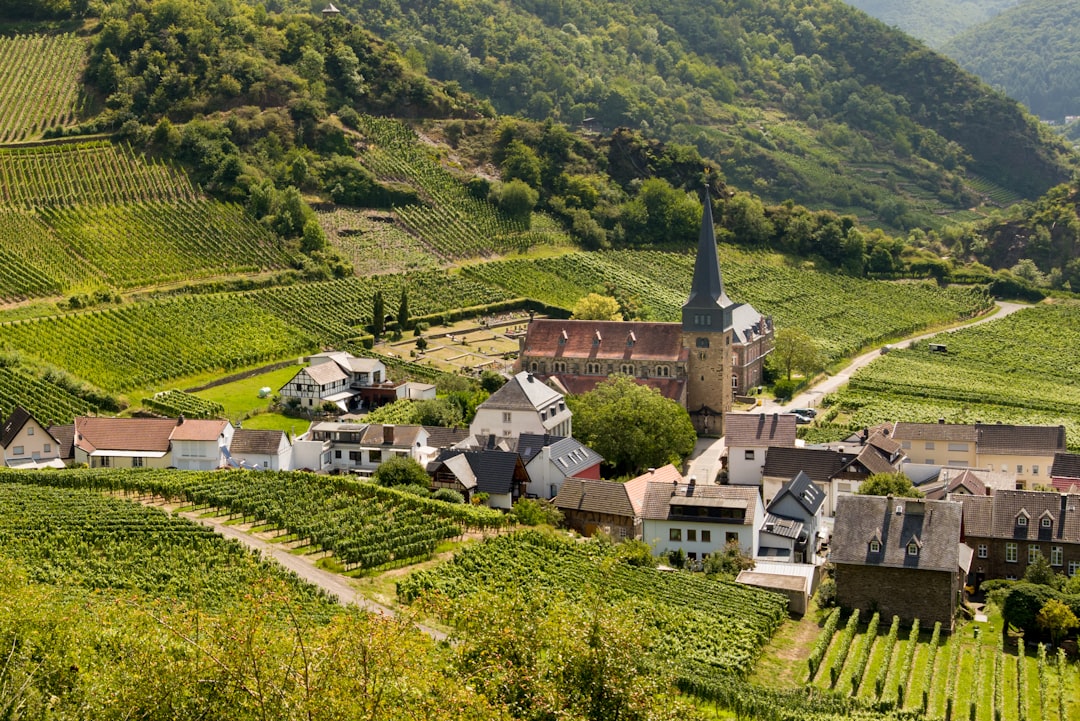
The iconic German wine region. Steep, slate-covered hillsides along the Mosel River produce Rieslings of extraordinary delicacy and precision. The best vineyards face south on gradients so steep (up to 65%) that everything must be done by hand.
Style: Light-bodied, low alcohol (often 7-10%), with laser-beam acidity, citrus, green apple, and wet slate minerality. Mosel Kabinett is one of wine’s great pleasures – featherweight but full of flavour.
Key villages: Bernkastel, Piesport, Wehlen, Ürzig, Brauneberg
Producers to try: Dr. Loosen, Joh. Jos. Prüm, Fritz Haag, Markus Molitor, Schloss Lieser
Rheingau
Historically Germany’s most prestigious region. Warmer than the Mosel, producing fuller-bodied, more structured Rieslings.
Style: Richer and more powerful than Mosel. Stone fruit (peach, apricot), herbs, and a broader, more textured palate.
Key villages: Johannisberg, Rüdesheim, Hattenheim, Eltville
Producers to try: Robert Weil, Schloss Johannisberg, Peter Jakob Kühn, Leitz
Pfalz (Palatinate)
Germany’s warmest major wine region. Produces ripe, generous Rieslings alongside excellent Pinot Noir (Spätburgunder), Pinot Blanc (Weissburgunder), and Pinot Gris (Grauburgunder).
Style: Fuller, riper, more fruit-forward than Mosel or Rheingau. Often dry. The most “New World” of German regions.
Producers to try: Müller-Catoir, Reichsrat von Buhl, Bürklin-Wolf, Christmann
Rheinhessen
Germany’s largest wine region by area. Quality varies enormously, but the best producers – concentrated around the Roter Hang (red slope) near Nierstein – make stunning dry Riesling and increasingly good Pinot Noir.
Producers to try: Keller (cult status), Wittmann, Battenfeld-Spanier, Wagner-Stempel
Nahe
A small region that produces some of Germany’s most underrated wines. Diverse soils create a range of styles, from mineral and precise to rich and complex.
Producers to try: Dönnhoff (one of Germany’s greatest producers), Schäfer-Fröhlich, Emrich-Schönleber
Baden
Germany’s southernmost region and the warmest. Known more for Pinot Noir (Spätburgunder) and Pinot Gris (Grauburgunder) than Riesling. The reds from top producers rival mid-range Burgundy.
Producers to try: Bernhard Huber (Pinot Noir), Salwey, Dr. Heger
Beyond Riesling
While Riesling dominates the conversation, Germany produces excellent wines from other grapes:
- Spätburgunder (Pinot Noir): Increasingly world-class from Baden, Pfalz, and Ahr. The best compete with Burgundy at a fraction of the price
- Weissburgunder (Pinot Blanc): Crisp, mineral, food-friendly. Excellent value
- Grauburgunder (Pinot Gris): Fuller than Pinot Grigio, often with more texture and interest
- Silvaner: Franconia’s signature grape. Earthy, herbal, excellent with food
What to Buy: A Starting Path
Entry Level ($10-16)
- Dr. Loosen “Dr. L” Riesling (~$10): Simple, off-dry, fruity. A friendly introduction
- Leitz “Dragonstone” Riesling (~$14): Off-dry, pure, and refreshing
- Fritz Haag Estate Riesling (~$16): Real Mosel character at a fair price
Mid-Range ($16-30)
- Dr. Loosen Wehlener Sonnenuhr Spätlese (~$25): One of the great Mosel vineyard Rieslings. Off-dry perfection
- Robert Weil Rheingau Riesling Trocken (~$20): Polished, dry, structured
- Dönnhoff Tonschiefer Riesling Trocken (~$22): Mineral and precise from Nahe slate soils
Splurge ($30+)
- Keller Westhofen Riesling Trocken (~$40): Cult status for a reason
- Joh. Jos. Prüm Wehlener Sonnenuhr Auslese (~$50): Liquid gold. Sweet, intense, almost eternal
- Any Grosses Gewächs from a top producer ($35-80): Germany’s answer to Grand Cru Burgundy
Serving German Wine
Temperature: Dry Riesling at 8-10°C. Off-dry and sweet Riesling at 6-8°C. German Pinot Noir at 14-16°C.
Food pairing: Riesling is arguably the most food-friendly white grape:
- Dry Riesling with sushi, Thai food, pork, chicken, seafood
- Off-dry Riesling with spicy cuisine (the residual sugar balances heat)
- Sweet Riesling (Auslese+) with foie gras, blue cheese, fruit desserts
- Spätburgunder with duck, salmon, mushroom dishes
German wine rewards curiosity. Start with a Mosel Kabinett, work your way through the regions, and you’ll quickly understand why the world’s best sommeliers consistently rate Riesling as one of the greatest grapes on earth.
Track your German wine exploration with Sommo and discover which regions and styles match your palate.
Photo by Marc-Philipp Esser on Unsplash