French Wine for Beginners: Where to Start
French wine can feel intimidating. Here's a straightforward guide to the major regions, what to drink, and where to start.
France is the reason wine culture exists as we know it. Nearly every major grape variety, winemaking technique, and classification system traces back to French innovation. It’s also the reason wine can feel needlessly complicated – because France labels wines by region instead of grape, uses a classification hierarchy that takes a PhD to fully understand, and has been doing things a certain way since before most countries existed.
But here’s the good news: you don’t need to understand all of it to drink well. You just need to know the major regions, their key grapes, and roughly what to expect when you open a bottle.
The French System: AOC/AOP in 30 Seconds
France classifies wines using the Appellation d’Origine Contrôlée (AOC), now officially AOP (Appellation d’Origine Protégée) under EU terminology. Both terms are used interchangeably.
The system works like a pyramid:
| Level | What It Means | Example |
|---|---|---|
| AOP (specific) | Strictest rules, smallest area, highest quality potential | Pauillac, Gevrey-Chambertin |
| AOP (regional) | Broader area, more flexibility | Bordeaux, Bourgogne |
| IGP | Regional wines with fewer restrictions | Pays d’Oc |
| Vin de France | Table wine, no geographic restriction | (various) |
The key insight: a more specific appellation generally means stricter rules and (theoretically) higher quality. A wine labeled “Pauillac” has passed more hoops than one labeled “Bordeaux.” But a skilled producer’s regional wine can absolutely beat a mediocre producer’s specific appellation.
Now, let’s tour the regions.
Bordeaux: The Big One
Bordeaux is the world’s most famous wine region, and also one of the most misunderstood. People hear “Bordeaux” and think $500 bottles and snooty auction houses. In reality, Bordeaux produces enormous quantities of very affordable wine alongside its famous estates.
Left Bank vs. Right Bank
The Gironde estuary and its tributaries divide Bordeaux into two distinct zones:
Left Bank (Médoc, Graves, Pessac-Léognan)
- Dominant grape: Cabernet Sauvignon
- Style: Structured, tannic, powerful, with blackcurrant, cedar, and graphite
- Famous appellations: Pauillac, Saint-Julien, Margaux, Saint-Estèphe
- Where to start: A Cru Bourgeois from the Médoc ($15-25) gives you the Bordeaux Left Bank experience without the prestige pricing
Right Bank (Saint-Émilion, Pomerol, Fronsac)
- Dominant grape: Merlot (often blended with Cabernet Franc)
- Style: Rounder, softer, more approachable, with plum, cherry, and chocolate
- Famous appellations: Saint-Émilion Grand Cru, Pomerol
- Where to start: Côtes de Bordeaux or Fronsac ($12-20) for excellent Right Bank character at entry prices
Bordeaux White
Often overlooked: Bordeaux makes outstanding white wines. Dry whites from Pessac-Léognan (Sauvignon Blanc/Sémillon blends) are complex and age-worthy. Sweet whites from Sauternes and Barsac are among the world’s greatest dessert wines.
Where to start: Entre-Deux-Mers for affordable, crisp Sauvignon Blanc-based whites ($8-14).
Burgundy: The Holy Grail
If Bordeaux is about power and structure, Burgundy is about finesse and terroir. This is the region that proves a single grape variety, grown in slightly different plots of land a few hundred meters apart, can taste completely different.
The Grapes
It’s simple here: Pinot Noir for reds, Chardonnay for whites. (Gamay and Aligoté exist in Burgundy too, but Pinot Noir and Chardonnay are the stars.)
The Classification
Burgundy’s quality pyramid is everything:
| Level | What It Means | Price Range |
|---|---|---|
| Grand Cru | The very best vineyards. Just the vineyard name on the label. | $80-$5,000+ |
| Premier Cru (1er Cru) | Excellent vineyards. Village + vineyard name. | $40-200 |
| Village | Wine from a specific village (e.g., Gevrey-Chambertin, Meursault). | $25-80 |
| Regional | Generic Bourgogne. Grapes from anywhere in Burgundy. | $12-30 |
Key Sub-Regions
- Chablis – Chardonnay, unoaked (mostly), lean, mineral, and steely. Great value at the village level.
- Côte de Nuits – Primarily Pinot Noir. Home to legendary Grand Crus like Romanée-Conti, Chambertin, and Musigny. The pinnacle of Pinot Noir.
- Côte de Beaune – Both Pinot Noir and Chardonnay. Meursault, Puligny-Montrachet, and Chassagne-Montrachet produce the world’s greatest Chardonnays.
- Côte Chalonnaise – More affordable alternatives: Mercurey, Givry (reds), Rully, Montagny (whites).
- Mâconnais – Chardonnay country. Pouilly-Fuissé and Saint-Véran offer creamy, approachable whites.
Where to start: Bourgogne Rouge or Bourgogne Blanc from a good producer ($15-25) teaches you the Burgundy style. Then step up to Côte Chalonnaise villages for more character.
The Rhône Valley: Two Regions in One
The Rhône Valley splits into two distinct halves that barely resemble each other.
Northern Rhône
- Key grape: Syrah (red), Viognier, Marsanne, Roussanne (white)
- Style: Elegant, peppery, structured reds; floral, rich whites
- Famous appellations: Côte-Rôtie, Hermitage (both legendary and expensive), Crozes-Hermitage, Saint-Joseph (more accessible), Condrieu (Viognier)
- Where to start: Crozes-Hermitage ($15-25) is the gateway to Northern Rhône Syrah – peppery, dark-fruited, and medium-bodied
Southern Rhône
- Key grapes: Grenache, Syrah, Mourvèdre (the “GSM” blend), Cinsault
- Style: Warm, generous, fruit-forward, spicy. Often blends rather than single varietals
- Famous appellations: Châteauneuf-du-Pape (up to 13 permitted grape varieties), Gigondas, Vacqueyras
- Where to start: Côtes du Rhône and Côtes du Rhône-Villages ($8-16) are some of the best-value wines in France. Seriously. A $12 Côtes du Rhône from a good producer is a revelation.
Loire Valley: France’s Most Versatile Region
The Loire produces everything: bone-dry whites, sweet whites, reds, rosés, and sparkling wines. It runs along the Loire River for over 600 miles, so styles vary enormously.
Highlights:
- Sancerre and Pouilly-Fumé – Sauvignon Blanc at its most elegant. Mineral, citrus, sometimes flinty.
- Vouvray – Chenin Blanc in every style: dry, off-dry, sweet, and sparkling.
- Muscadet – Melon de Bourgogne grape. Bone-dry, mineral, perfect with seafood. Criminally underpriced.
- Chinon and Bourgueil – Cabernet Franc reds. Lighter than Bordeaux, with raspberry, bell pepper, and earthy notes.
Where to start: Muscadet Sèvre-et-Maine Sur Lie ($9-14). One of the greatest values in all of French wine.
Alsace: The French Exception
Alsace sits on the German border and it shows. Tall, slim bottles. Germanic grape varieties. And – unusual for France – wines labeled by grape rather than appellation.
Key grapes: Riesling, Gewürztraminer, Pinot Gris, Muscat, Pinot Blanc
Style: Aromatic, mostly dry (despite the grape varieties’ association with sweetness elsewhere), and intensely varietal. Alsatian Riesling is one of the great dry white wines of the world.
Where to start: Alsace Riesling ($14-22). Bone-dry, mineral, and completely distinct from German Riesling.
Champagne: Briefly
We covered sparkling wine in depth in our sparkling wine guide, but the essentials: Champagne is made from Chardonnay, Pinot Noir, and Pinot Meunier using the traditional method. It’s the benchmark for all sparkling wine and genuinely deserves its reputation – just not its price tag for non-vintage bottles.
Where to start: Grower Champagne ($30-50) from producers who grow their own grapes, rather than the big houses. Look for “RM” (Récoltant-Manipulant) on the label.
Languedoc-Roussillon: The Value King
This massive region in southern France was once known for bulk wine production. Today, it’s one of the most exciting and affordable wine regions in the world.
Key grapes: Grenache, Syrah, Mourvèdre, Carignan (reds); Picpoul, Viognier, Grenache Blanc (whites)
Style: Sun-drenched, generous, Mediterranean. Think Southern Rhône character at lower prices.
Where to start: Pic Saint-Loup or Minervois reds ($10-18). Picpoul de Pinet for a crisp, lemony white ($9-14).
A Quick Reference Table
| Region | Key Red Grape(s) | Key White Grape(s) | Entry Price | Character |
|---|---|---|---|---|
| Bordeaux (Left) | Cabernet Sauvignon | Sauvignon Blanc/Sémillon | $12 | Structured, classic |
| Bordeaux (Right) | Merlot | – | $12 | Round, approachable |
| Burgundy | Pinot Noir | Chardonnay | $15 | Elegant, terroir-driven |
| Northern Rhône | Syrah | Viognier | $15 | Peppery, refined |
| Southern Rhône | Grenache blends | Grenache Blanc blends | $8 | Warm, generous |
| Loire | Cabernet Franc | Sauvignon Blanc, Chenin | $9 | Versatile, fresh |
| Alsace | Pinot Noir (minor) | Riesling, Gewürz | $14 | Aromatic, precise |
| Languedoc | Grenache, Syrah | Picpoul, Viognier | $9 | Mediterranean value |
Your French Wine Journey
French wine rewards curiosity. Start with the affordable entries – Côtes du Rhône, Muscadet, Côtes de Bordeaux, Bourgogne – and work your way up as your palate develops and your budget allows. The beauty of France is that every price point has something worthwhile.
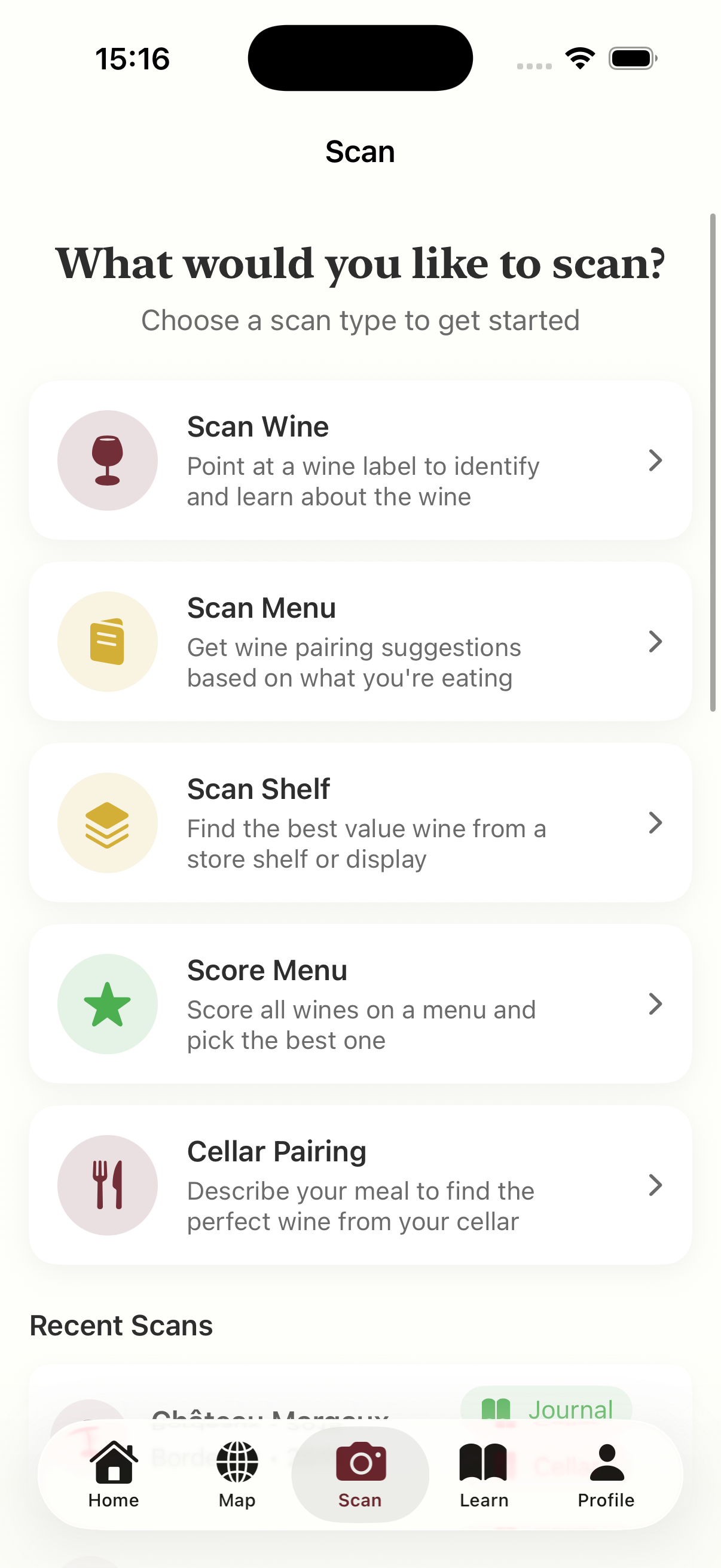
Sommo’s AI label scanner is particularly handy with French wines, since the labels rarely tell you which grape is inside the bottle. Scan, learn the grape and region, log your tasting notes, and build a personal map of French wine. The app’s interactive wine region map lets you explore appellations visually, and the WSET learning modules cover French wine regions in detail with flashcards that actually help you remember the difference between Côte-Rôtie and Côtes du Rhône. Because with French wine, the details matter – and they’re worth knowing.
Liked this read? Try the app.
Scan any wine label with AI, build your tasting journal, and learn wine your way.