Your First European Wine Trip: 2026 Guide
First-timers spend 40% more and see 60% less by visiting too many regions. Here's how to plan a wine trip that actually delivers.
You’ve decided to visit European wine country. Centuries-old cellars. Vineyards stretching to the horizon. Tastings with actual winemakers.
Then you open Google Maps and see that Bordeaux, Burgundy, Champagne, Tuscany, and Rioja are each 500+ kilometers apart. Reality hits: you can’t do them all.
Here’s the uncomfortable truth: First-timers who try to visit multiple regions spend 40% more on transportation and see 60% less of what makes each place special. They return exhausted, with blurry memories of wine they can’t remember.
This guide helps you plan a trip that actually delivers on the fantasy.
The One Rule That Changes Everything
Pick one region. Go deep instead of wide.
France alone has dozens of major wine regions spread across the entire country. Trying to do Burgundy, Bordeaux, and Champagne in one week means you’ll spend more time in cars and trains than in vineyards.
One region for your first trip gives you:
- Relaxed pace (no rushing between airports)
- Genuine understanding of local wines
- Memories you’ll actually retain
- Less logistical stress
- Better value for money
The 5 Best Regions for First-Time Wine Travelers
1. Tuscany, Italy (Best Overall for Beginners)
The appeal: Rolling hills, cypress trees, medieval villages. It’s what most people picture when they imagine wine country.
Why first-timers love it:
- Stunning landscapes require zero wine knowledge to appreciate
- Easy to navigate by car
- Food is equally celebrated (no pretense about wine-only focus)
- Italians are famously welcoming to beginners
- Towns like Florence and Siena offer culture beyond wine
Signature wines: Chianti Classico, Brunello di Montalcino, Vino Nobile di Montepulciano
Best base: Montepulciano (charming town), Pienza (UNESCO village), or an agriturismo (farm stay)
Budget: €100 to €200/day including accommodation, tastings, and meals
2. Rioja, Spain (Best Value)
The appeal: Incredible hospitality, world-class food scene, and prices 30 to 40% lower than French regions.
Why first-timers love it:
- Many tasting rooms don’t require appointments
- Spanish warmth makes beginners feel welcome
- Affordable compared to France or Italy
- Easy to combine with San Sebastián (world’s best food city)
- Modern “Starchitect” wineries are visually stunning
Signature wines: Tempranillo-based reds, crisp whites, aged Reserva and Gran Reserva wines
Best base: Haro (wine capital), Laguardia (medieval walled town), or Logroño (great food scene)
Budget: €80 to €150/day including accommodation, tastings, and meals
3. Champagne, France (Best for Short Trips)
The appeal: One hour from Paris by train. Compact region. Names you already know.
Why first-timers love it:
- Everyone knows what Champagne is
- Dramatic underground cellars carved from chalk
- Can be done as a Paris add-on (2 to 3 days)
- Famous houses (Moët, Veuve Clicquot, Taittinger) welcome visitors
- Smaller grower Champagnes offer discovery
Signature wines: Sparkling wine (Brut, Blanc de Blancs, Rosé)
Best base: Reims (larger city, more houses) or Épernay (smaller, Avenue de Champagne)
Budget: €120 to €220/day including accommodation, tastings, and meals
4. Douro Valley, Portugal (Best Scenery)
The appeal: UNESCO World Heritage terraced vineyards along the Douro River. Dramatic doesn’t begin to describe it.
Why first-timers love it:
- Port wine cellars in Porto offer easy introductory tastings
- Wine tourism infrastructure is excellent
- Significantly more affordable than France
- River cruises provide effortless access
- Emerging dry wine scene is exciting
Signature wines: Port (Ruby, Tawny, Vintage), Douro dry reds and whites
Best base: Porto (city + cellars), Pinhão (river town), or a quinta (wine estate)
Budget: €70 to €140/day including accommodation, tastings, and meals
5. Burgundy, France (For Wine Enthusiasts)
The appeal: The legendary home of Pinot Noir and Chardonnay. Deep wine culture.
Why to consider it (with caveats):
- Burgundy is harder to navigate
- Wineries are small and often require appointments months in advance
- Wines can be expensive (entry-level bottles start at €25+)
- Best saved for your second or third wine trip unless Burgundy specifically calls to you
Signature wines: Red and White Burgundy (Pinot Noir, Chardonnay)
Best base: Beaune (wine capital), Meursault, or Gevrey-Chambertin
Budget: €150 to €300/day including accommodation, tastings, and meals
The Complete Planning Timeline
3+ Months Before
- Choose your region (use the comparison chart below)
- Book flights (flexibility on dates saves €100+)
- Reserve accommodation (agriturismos and wine hotels book up)
- Request appointments at must-visit wineries (famous estates require lead time)
1 Month Before
- Finalize winery appointments (2 to 3 per day maximum)
- Book restaurant reservations (especially Michelin-starred)
- Reserve rental car if needed
- Research which wines to look for
1 Week Before
- Download offline maps
- Confirm all reservations via email
- Pack appropriate footwear (vineyards require walking)
- Brief yourself on basic tasting vocabulary
Logistics Decoded
Transportation Reality
Rental car: Essential for Tuscany, Rioja, Douro, and most of Burgundy. Vineyards are spread across countryside. Trains and buses won’t cut it.
The drinking-and-driving problem: This is real. Solutions:
| Approach | Pros | Cons |
|---|---|---|
| Spit at tastings | Professional practice, free | Requires discipline |
| Designate a driver daily | One person drinks freely | Unfair rotation |
| Hire a driver (€200 to €400/day) | Both taste fully | Expensive |
| Stay walkable to wineries | No driving stress | Limits options |
| E-bike rentals | Exercise + freedom | Limited range |
Appointment Culture by Region
| Region | Appointment Required? |
|---|---|
| Champagne | Almost always (book 2+ weeks ahead) |
| Burgundy | Usually required (book 1+ month ahead) |
| Bordeaux | Required for major châteaux |
| Tuscany | Often drop-in friendly |
| Rioja | Mixed, many accept walk-ins |
| Douro | Most welcome drop-ins |
Pro tip: Email wineries directly in their native language (use Google Translate). Smaller producers often welcome visitors even without formal booking systems.
Tasting Costs (2026 Estimates)
| Experience Level | Typical Cost |
|---|---|
| Basic tasting (3 to 5 wines) | €15 to €30 |
| Premium tasting (reserve wines) | €40 to €100 |
| Champagne house tour + tasting | €30 to €75 |
| Tour with food pairing | €50 to €100 |
| Private VIP experience | €150+ |
Budget for 2 to 3 tastings per day maximum. Palate fatigue is real, and you’ll appreciate less wine more.
The Ideal First-Trip Day
Morning:
- Late breakfast at your accommodation (no rush)
- First winery visit at 10:30 or 11:00am
- Take your time, ask questions, walk the vineyards
Midday:
- Long lunch at a winery restaurant or local bistro (2 hours)
- Rest your palate
Afternoon:
- One more winery visit at 3:00 or 4:00pm
- Leisurely drive through the landscape
Evening:
- Dinner at a local restaurant
- Try regional wines you haven’t tasted yet
- Review your notes from the day
This pace is sustainable for a week. Rushing through five wineries per day is exhausting, and you won’t remember anything.
Best Time to Visit (Season Comparison)
| Season | Pros | Cons |
|---|---|---|
| Spring (April to May) | Mild weather, fewer crowds, lower prices | Vineyards not at peak green |
| Early Summer (June) | Long days, full foliage, great weather | Prices increasing |
| Harvest (Sept to Oct) | Peak beauty, active wineries, exciting energy | Some wineries too busy for tours |
| Off-season (Nov to Mar) | Cheapest, quietest, no crowds | Gray weather, some wineries closed |
Sweet spot: Late May or early October. Shoulder season pricing, pleasant weather, available appointments.
Questions to Ask at Every Winery
Questions that open great conversations:
- “What makes this vintage different from last year?”
- “Which wine is your personal favorite to drink at home?”
- “What local dish would you pair with this?”
- “How long has your family been making wine here?”
Questions to avoid:
- “Which one is the best?” (They’re all the winemaker’s children)
- “Can I get a discount?” (Generally no, and it’s awkward)
First-Trip Mistakes to Avoid
Overbooking: 2 to 3 wineries per day maximum. More than that, and you’ll remember nothing.
Skipping lunch: European wine culture includes food. Don’t power through on energy bars.
Ignoring local wines: That obscure regional grape might become your favorite discovery.
Not taking notes: Use Sommo or a notebook to record what you taste. You will forget.
Forgetting to look up: The landscape is part of the experience. Put your phone down sometimes.
Region Comparison Chart
| Factor | Tuscany | Rioja | Champagne | Douro | Burgundy |
|---|---|---|---|---|---|
| Cost level | Medium | Low | High | Low | High |
| Navigation ease | Easy | Easy | Easy | Medium | Hard |
| Appointment needs | Low | Low | High | Low | High |
| Food scene | Excellent | Excellent | Good | Good | Excellent |
| Beginner friendly | Very | Very | Moderate | Very | Challenging |
| Trip length needed | 5 to 7 days | 4 to 6 days | 2 to 4 days | 4 to 6 days | 5 to 7 days |
First timer? Tuscany or Rioja. More welcoming, easier logistics.
Adding to Paris trip? Champagne.
Best value? Douro or Rioja.
Serious wine student? Burgundy (but prepare thoroughly).
Your first wine trip should build excitement for future trips, not exhaust you. Go deep in one region, and you’ll return home with genuine understanding instead of superficial memories.
Liked this read? Try the app.
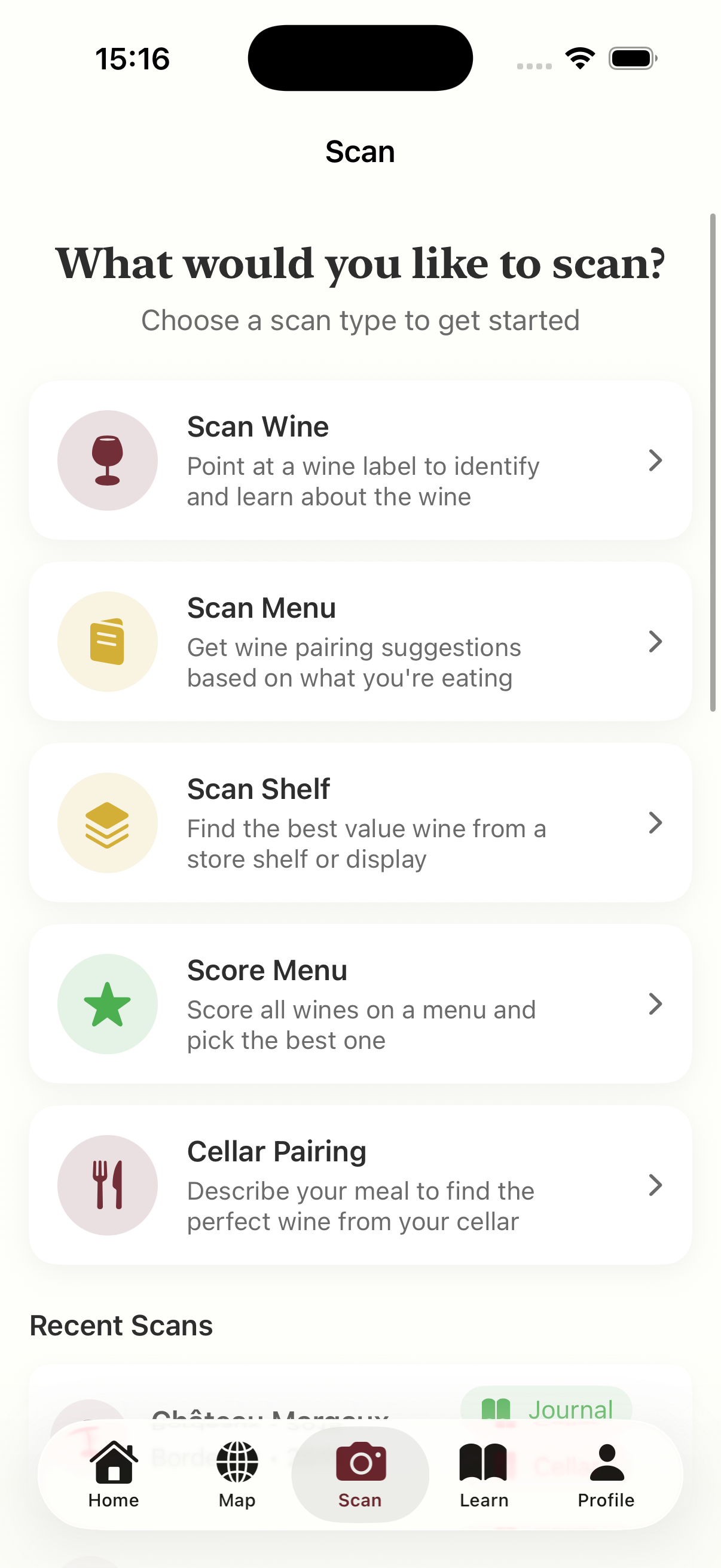
Scan any wine label with AI, build your tasting journal, and learn wine your way.