I study wine for the same reason I built Sommo: I want to understand what is in the glass, not just enjoy it. The Court of Master Sommeliers is the path that turns that curiosity into a profession on the restaurant floor.
The short answer: the Court of Master Sommeliers is a sommelier qualification body with four levels, Introductory, Certified, Advanced and Master. The Introductory exam is mainly theory, with a short service test in Europe, and from Certified upwards every level tests theory, blind tasting and wine service. It is aimed at people who serve wine for a living. WSET, by contrast, is a knowledge qualification with no service exam. Below is what each Court level involves, what it costs in the Americas, and how to decide between the two.
What is the Court of Master Sommeliers?
The Court of Master Sommeliers sets exams for sommeliers: the people who choose, sell and serve wine in restaurants. Its qualifications test three things together, and that combination is what makes them distinctive:
- Theory: wine regions, grapes, laws, spirits, beer and the business of beverage.
- Deductive tasting: identifying wines blind using a structured method.
- Service: opening, decanting and pouring correctly, and selling with grace under pressure.
There is more than one Court. The Court of Master Sommeliers Americas runs exams in the Americas, and the Court of Master Sommeliers Europe runs exams in Europe and other regions. The levels share names, but formats, fees and rules differ, so always check the Court that covers you. The figures in this guide come from the Americas unless I say otherwise.
What are the four Court of Master Sommeliers levels?
Level 1: Introductory Sommelier Course and Examination
The entry point. In the Americas it is a two day course followed by an exam of 70 multiple choice questions in 45 minutes, with a pass mark of 60%. The Court lists $949 for the in-person course, wines included, and $649 online, with wines sold separately.
In Europe, the Introductory exam combines a multiple choice theory paper with a short practical service test, and you need 60% in each part. One detail to know: the Americas Court notes that CMS Europe does not recognise the online Introductory course as a prerequisite for its Certified exam.
My Introductory practice tests are free on the web if you want to see the style of question before you book.
Level 2: Certified Sommelier Examination
This is where it gets real. The Certified exam is one day with three sections:
- Tasting: describe and identify four wines, two white and two red, in writing, in 45 minutes.
- Theory: 45 questions in 38 minutes, mixing multiple choice, short answers, simple maths and matching.
- Hospitality and service: a practical test that approximates a real restaurant.
The Americas Court lists the exam at $849 and strongly suggests about three years of industry experience. My Certified practice tests cover the theory side.
Level 3: Advanced Sommelier Course and Examination
Advanced is a serious professional step. In the Americas, candidates need industry experience and must complete the Advanced course before sitting theory, then the practical and tasting sections. You need 60% in each part.
Level 4: Master Sommelier Diploma Examination
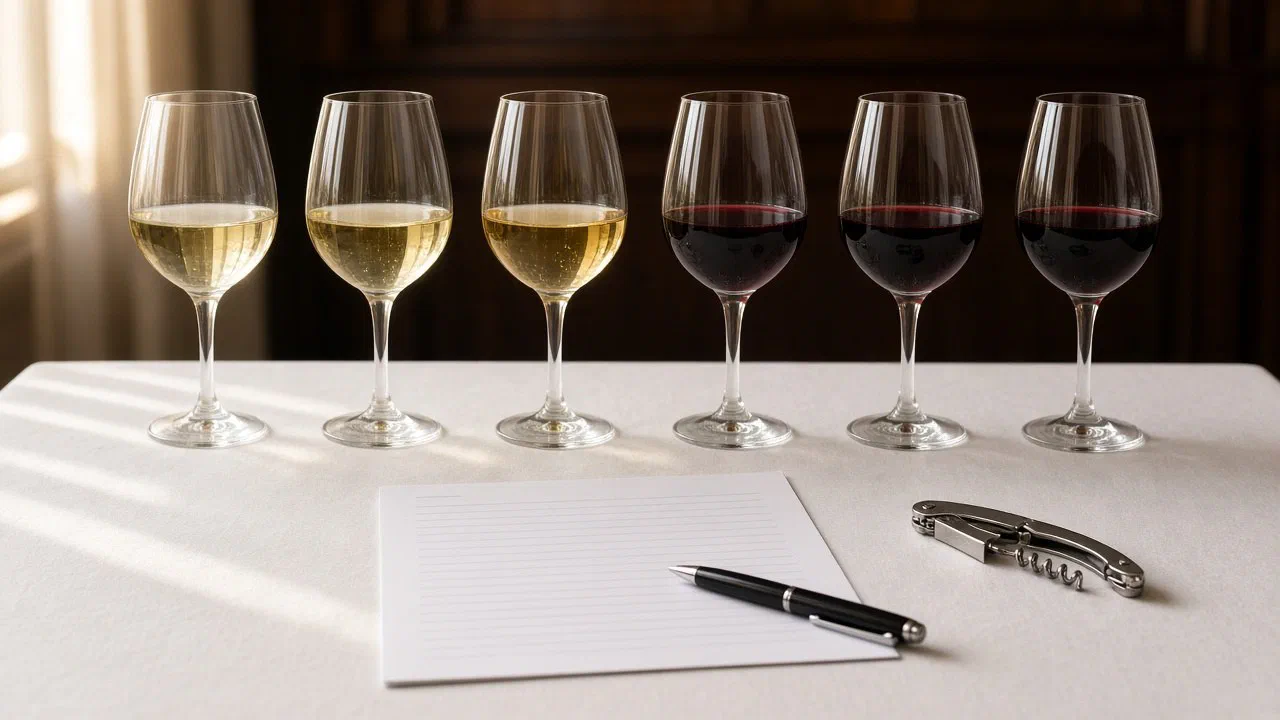
The top of the ladder. The Master Sommelier Diploma has three parts: an oral theory exam, a deductive tasting of six wines in 25 minutes, and a practical service and business exam. The pass mark is 75% in each part. Candidates must pass theory first, then have three consecutive years to pass the other two.
What does the deductive tasting exam involve?
Blind tasting is the part people fear and the part that builds the most skill. The method is a fixed sequence: sight, nose, palate, then an initial conclusion and a final conclusion about grape, region and vintage. You talk, or write, your way through a grid in a set order, so that your conclusion follows from evidence rather than a guess.
The best preparation is repetition with structure. Taste the classic grapes side by side, say every observation out loud, and check your call against the answer. Our free deductive tasting grid lets you work through the sheet on screen and print a blank copy for practice.
How does the Court of Master Sommeliers compare with WSET?
| Court of Master Sommeliers | WSET | |
|---|---|---|
| Focus | Restaurant sommelier skills | Wine knowledge for any wine career |
| Exams | Theory, blind tasting and service from Certified upwards | Theory, plus tasting from Level 3 |
| Service exam | Yes, from Introductory in Europe and Certified in the Americas | No |
| Entry level | Introductory: 70 questions, 45 minutes (Americas) | Level 1: 30 multiple choice questions |
| Study time | Course days plus self study | Level 2: at least 28 hours; Level 3: at least 84 hours |
| Regulation | Court’s own credential | Levels 1 to 3 regulated by Ofqual |
The WSET figures come from WSET’s own pages: Level 1 requires at least six hours of study and a closed book exam of 30 multiple choice questions; Level 2 requires at least 28 hours, including 16 hours with a course provider; and Level 3 requires at least 84 hours and includes a blind tasting of two wines.
For a longer side by side, see my WSET versus CMS comparison. If you are not sure you want a formal qualification at all, read can you learn wine without WSET?.
Which wine qualification should you choose?
- You work in a restaurant or want to: start with the Court’s Introductory level. Service and tasting are what the floor demands.
- You work in retail, import, marketing or writing: WSET is the more natural fit, because it covers wine knowledge without a service exam.
- You are a curious enthusiast: WSET Level 1 or 2 gives you structure without needing industry experience.
- You want both: plenty of sommeliers hold WSET qualifications as well as Court ones. The knowledge overlaps and each helps with the other.
How can Sommo help you study for sommelier and WSET exams?
I built Sommo’s study tools because the hardest part of exam prep is not reading. It is remembering, under pressure, months later.
- Free web practice. Sommo’s WSET hub has free practice for Levels 1 to 4, alongside the free Introductory and Certified sommelier practice tests and the tasting grid.
- Revision in the app. WSET exam prep in Sommo gives you flashcards, quizzes and mock exams. WSET Level 1 is free in the app. Levels 2 to 4 and adaptive practice that brings back what you keep getting wrong need Premium.
- Taste with purpose. Scan the label of every wine you practise with, and Sommo gives you its grapes, region and typical profile in seconds. Log your tasting note in the journal, and with Premium, AI tasting feedback tells you how close you were to the wine’s known profile.
Behind it is proprietary wine-tuned AI grounded in a hand-maintained wine library, so what you revise from is wine fact, not guesswork. The free tier gives you 5 lifetime AI scans per device, shared across label, menu and shelf scans, plus the journal and 30 days of journal history. Premium is $4.99 a month or $29.99 a year in the US; prices vary by country and store. Sommo runs on iPhone, iPad, Android, HarmonyOS and the web.
Download Sommo and start revising today.
The bottom line
The Court of Master Sommeliers is the qualification for people who serve wine. It has four levels, from a two day Introductory course to the Master Sommelier Diploma with its 75% pass mark in every part, and from Certified upwards it tests theory, blind tasting and service together. WSET is the broader knowledge route. Pick the one that matches the job you want, then revise little and often.