Choose offsite wine storage around the retrievals you expect to make, then check custody, insurance and the complete bill. A facility suited to holding untouched cases for years may be inconvenient for a collector who wants two bottles for Friday dinner. Good environmental conditions are essential, but they are only part of the service.
Write down what will leave home: quantities, formats, original or mixed cases, approximate holding period and expected withdrawals. Keep everyday bottles separate from stock you will seldom need. The storage guide covers the underlying conditions; this decision is about paying another organisation to look after and return specific wine.
Ask how you get a bottle back
Find out whether you can collect personally, arrange delivery or nominate another collector. Ask about notice periods, order cut-offs, working days, delivery areas and charges. Confirm whether a withdrawal must be a whole case or can be individual bottles, and what opening or repacking a case costs.
Ask for the process during busy periods, not just a usual delivery promise. An evening event may depend on dispatch timing, transport conditions and who can receive the delivery. Keep a small home reserve if the service cannot reliably meet your dinner timetable.
For a hypothetical 60-bottle collection, 48 bottles might be for long-term keeping and twelve for dinners over the next few months. Compare the service once for an untouched year and again for four small withdrawals. Those are different purchasing decisions even though both begin with five twelve-bottle cases.
Compare written answers on the same worksheet
| Question | Evidence to obtain |
|---|---|
| What exactly is stored in my name? | Receipt and stock statement with wine, vintage, format and quantity |
| Who may instruct a withdrawal? | Account authority and identity-check procedure |
| How quickly can I retrieve it? | Written process, cut-off, delivery area and busy-period terms |
| What does each action cost? | Storage, receiving, handling, repacking, withdrawal and transport charges |
| Who covers loss or damage? | Actual insurance arrangements, exclusions, valuation basis and claims procedure |
| How do I leave? | Notice, outstanding charges, transfer procedure and final stock reconciliation |
For bonded wine, establish its status and the paperwork and taxes relevant to the intended release or transfer. Get a written total for your particular movement rather than assuming a storage tariff is the cost of receiving wine at home.
Separate insurance from the warehouse’s liability
A reassuring description of secure storage is not an insurance policy. Determine whether you arrange insurance, the merchant provides it or the storage operator does. Check what happens during transit and whether the insured basis matches your records.
Checked on 10 October 2026, the London City Bond terms published for private individuals say that the company does not insure the goods and that customers must arrange insurance. By contrast, Octavian’s service description, checked on the same date, describes current-market-value cover for wine destroyed if its facility is damaged. These are examples of why the distinction matters, not assurances about the agreement you will sign.
Read the terms for your actual account, especially when a merchant sits between you and the warehouse. Ask which organisation is your contractual counterparty and which documentation confirms your interest in the stored wine. A photograph of a case or a merchant’s online balance alone may leave important questions unanswered.
Reconcile the first receipt before sending the rest
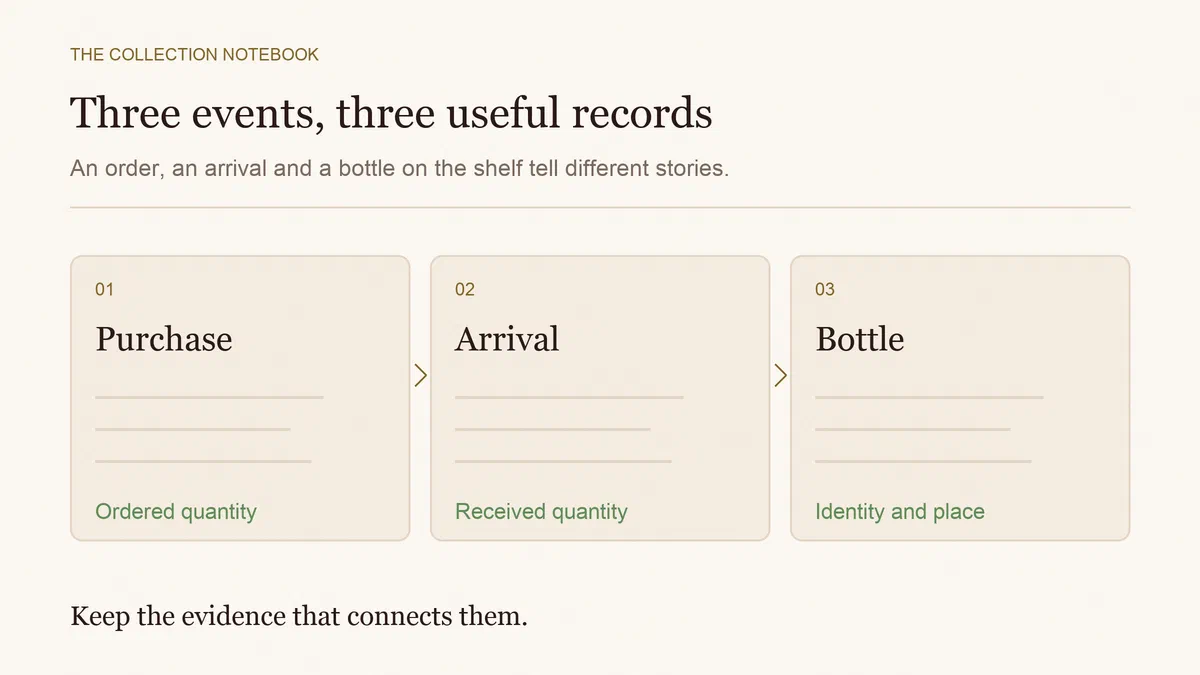
Start with a manageable transfer. Photograph case markings and keep the dispatch list. When the facility confirms receipt, compare wine, cuvée, vintage, bottle size, quantities and any condition observations with that list. Raise discrepancies through the stated process promptly.
Keep an independent copy of the stock statement and movement history. A location convention such as “Offsite / Case 03” should identify the actual case in your own records, not just an attractive label in an app. The inventory template helps with that convention; the CellarTracker and InVintory comparison explores the different collection-record jobs.
Test one ordinary retrieval
Before relying on the arrangement for an important occasion, request a normal withdrawal. Record what was requested, confirmed, dispatched and received, plus the final charge. Check the bottles on arrival. Use that experience to decide whether the remaining stock belongs there.
Update both locations after a real transfer. If two bottles come home from a twelve-bottle case, your records should show ten offsite and two at home, without changing the total owned. Keep transport and custody documents separately.
If you use Sommo Premium, keep eligible cellar placements and notes aligned with the wine you actually hold. Your external statement remains the evidence of what the facility reports holding; an app location is not proof of custody or insured cover.