There are two ways people now ask a machine about wine, and they are almost comically different.
One is to open ChatGPT and type a question in plain English. It answers immediately, in whole sentences, and sounds like it knows what it is talking about. Usually it does.
The other is to open Vivino and point a camera. No sentences, just a number, drawn from the accumulated opinion of around 70 million people.
Both are useful. Both fail in ways the other does not. And there is a third thing neither of them does, which is probably what you actually wanted.
The Short Answer
ChatGPT is an encyclopaedia that talks. It explains, contextualises, and teaches concepts well. It has no eyes, no live prices, and no memory of your palate between conversations.
Vivino is a verdict machine. It sees the bottle, knows what it costs, and reports what a very large crowd thought. It explains almost nothing.
| ChatGPT | Vivino | |
|---|---|---|
| Best at | Explaining wine | Judging a specific bottle |
| Sees the label | Only if you show it a photo | Yes, fastest in the category |
| Live prices | No | Community prices plus marketplace |
| Bottle-level data | General knowledge only | ~16 million wines as of mid-2026 |
| Remembers your taste | Not across conversations by default | No, ratings are the same for everyone |
| Structured tasting | No | No |
| Cost | Free tier, paid plans available | Free with ads; Premium $4.99/mo or $47.90/yr |
Where ChatGPT Genuinely Wins
Explanation. If you want to know why Left Bank and Right Bank Bordeaux taste different, what malolactic fermentation actually does, or how to read a German wine label, a general model will give you a clear, well-organised answer in seconds. That is real value, and Vivino offers nothing comparable.
It is also good at framing a decision. “I am cooking a mushroom risotto and want something under £20, what styles should I look at?” produces a sensible shortlist of styles with reasons attached. As a starting point, that beats staring at a shelf.
Where it breaks down: it cannot see. It does not know what is actually on the shelf in front of you, what the shop is charging, or whether the 2022 of that producer was any good. Ask about something specific and recent and you are relying on general knowledge rather than verified fact, which is exactly the situation where confident-sounding answers are most dangerous.
And it does not remember you. Every conversation starts blank, so the twelve wines you loved last year inform nothing. It cannot notice that you consistently rate high-acid whites highly and heavily oaked reds poorly, because it has never seen your ratings.
Where Vivino Genuinely Wins
Specificity. Vivino knows this bottle. Not the category, not the region, this exact wine, with a price and a rating from people who drank it. That grounding is something no general model has, and it is why the scan-and-decide flow remains the single most-used interaction in wine software.
The database is the moat: around 16 million wines as of mid-2026, covering supermarket own-labels and obscure co-op bottlings that no reference work would bother with.
Where it breaks down: it explains nothing. A 4.1 is not an education. You learn that people liked it, not why, not what it is, and not whether you specifically will. The ratings compress into a narrow band. And your own reviews go into an unstructured text box that never comes back to you as anything useful.
Head to Head
“What is this bottle?”
Vivino. It sees the label and looks it up. ChatGPT needs you to type the name accurately and then gives you general information about the producer or region rather than the bottle.
“What is a Cru Bourgeois?”
ChatGPT. Clear explanation, in context, with follow-up questions allowed. Vivino has no answer to a conceptual question.
“Is £24 a fair price for this?”
Vivino, with the caveat that its price data is community-reported rather than a full market survey. ChatGPT has no live pricing at all, and a confident guess is worse than no answer.
“What should I drink with slow-roast pork belly?”
ChatGPT gives a better reasoned answer about style. Vivino gives you buyable bottles. Between the two you can get there, in two apps, in about four minutes. Neither can look at what is already in your kitchen.
“Am I getting better at this?”
Neither has any concept of your progress. ChatGPT has no memory of your tasting history by default. Vivino has your scan history but does nothing meaningful with it. Both treat every question as the first question you have ever asked.
The Common Failure
Line up the weaknesses and they point the same direction.
ChatGPT knows wine in general but nothing about you or the bottle in front of you. Vivino knows the bottle and the crowd but nothing about you and cannot explain itself. In both cases the missing variable is the same: you.
That is not a small gap. Wine preference is idiosyncratic in a way that averages destroy. Two people can taste the same Sancerre and reasonably reach opposite conclusions, and no crowd score or general model can adjudicate that, because neither has any record of what either person has enjoyed before.
What a Wine Tool Should Actually Do
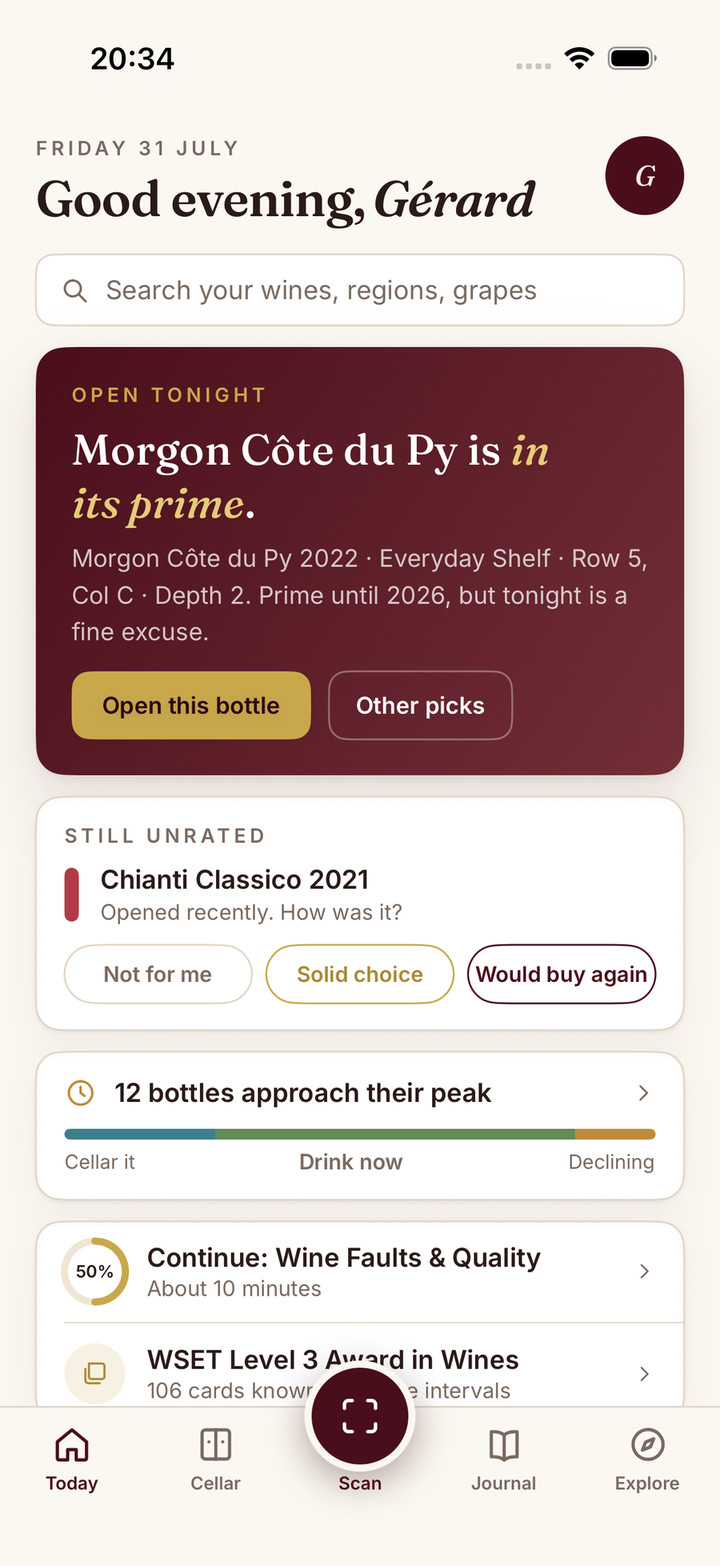
Sommo is built around the variable both of these leave out.
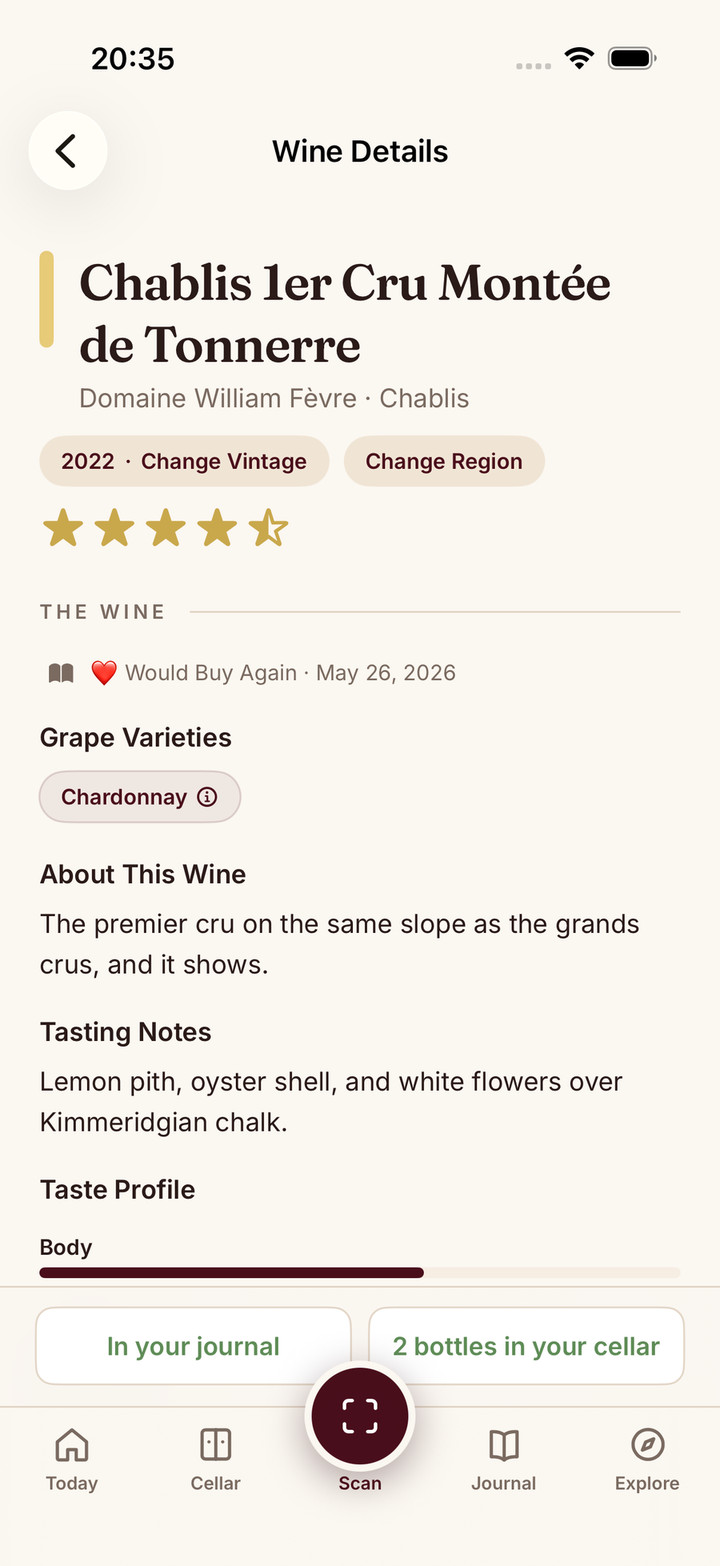
It sees, like Vivino. AI label scanning identifies the bottle from a photo, including awkward back labels and low light. But the answer is a briefing rather than a score: what the region does to the grape, what to expect in the glass, and what to eat with it. That is the ChatGPT-style explanation, delivered about the specific bottle in your hand rather than the category it belongs to.
It remembers, unlike either. Every tasting note follows the WSET SAT structure, and the AI marks it, telling you what you caught and what you missed. Those notes accumulate into a palate profile and a Taste DNA fingerprint, so recommendations are based on your history rather than a crowd average or a blank conversation.
And it acts on what it knows. Describe tonight’s dinner and the cellar picks from the bottles you actually own, with reasoning. Photograph a restaurant wine list and menu scoring ranks the whole thing on quality and value. Study for WSET Levels 1 to 4 and typed free-text answers are graded like an examiner would grade them.
Where it does not compete: no marketplace, no price comparison, no crowd average, and it will not write your dissertation. For general knowledge questions ChatGPT is excellent and free, and for checking whether strangers liked a bottle Vivino is excellent and free. Sommo is the tool for the part those two cannot reach.
There is a longer version of this argument specifically about general models at ChatGPT vs Sommo.
All Three, Side by Side
| Sommo | ChatGPT | Vivino | |
|---|---|---|---|
| Identifies a bottle from a photo | Yes, with a full briefing | Limited | Yes, fastest in the category |
| Explains what you are drinking | Yes, per bottle | Yes, in general | No |
| Live prices | No | No | Yes, plus marketplace |
| Crowd ratings | No | No | Yes, the category standard |
| Remembers your palate | Yes, from your journal | Not across conversations by default | No |
| Structured tasting notes | SAT with AI feedback | No | Free text and stars |
| Pairs from your own cellar | Yes | No | No |
| Scores a restaurant wine list | Yes, Premium | No | Wine-list scan, Premium |
| WSET exam prep | Levels 1 to 4, AI-graded typed answers | General Q&A only | No |
| Price | Free tier; Premium $5/mo or $29.99/yr | Free tier, paid plans | Free with ads; $4.99/mo |
The Bottom Line
Use ChatGPT to learn what wine is. Use Vivino to find out whether strangers liked the bottle you are holding. Both are good at those jobs and neither costs anything to start.
Just notice that after a year of both, you may have asked hundreds of questions and kept no connected wine life. The tool worth adding is the one that remembers what you scanned, where it sits, what fitted dinner, what you thought, who tasted with you and what the pattern says about your palate.
Try Sommo free, or read why it is built as one independent wine app rather than another chat or marketplace.
ChatGPT or Vivino for your wine question?