If you own more than a hundred bottles, you almost certainly have both of these open in adjacent browser tabs. One tells you what is in the cellar. The other tells you what it is worth and where to buy more.
They overlap just enough to make people ask which one they need, and they diverge just enough that the answer is usually “both, awkwardly.” Here is the honest breakdown.
The Short Answer
CellarTracker is the inventory system. Unlimited bottles, free, since 2003, with over 14 million community tasting notes and the best drinking-window consensus available anywhere.
Wine-Searcher is the market index. Roughly 8 million offers from tens of thousands of merchants, which makes it the reference for what a wine actually costs today.
Neither is trying to be the other, and neither talks to the other.
| CellarTracker | Wine-Searcher | |
|---|---|---|
| Core job | What do I own, and when do I drink it? | What does it cost, and who has it? |
| Inventory capacity | Unlimited, free | 25 wines free, 500 on PRO |
| Rack positions | Yes, detailed | No |
| Drinking windows | Community consensus, best in class | No |
| Valuation | Yes, sharper on paid tiers | Live market, best in class |
| Tasting notes | 14m plus community notes, 100-point | 5-star with free text |
| Buying | No | Best in class |
| Price | Free unlimited; $40 to $500/yr tiers | Free with sponsored results; PRO $8.25/mo billed annually |
Pricing as of mid-2026.
What CellarTracker Is Best At
Depth of record. CellarTracker treats a bottle as an object with a history: where it sits, what you paid, when you bought it, what happened when you opened one, and what several thousand other owners thought when they opened theirs.
That community archive is the part nobody can replicate quickly. Over 14 million tasting notes, weighted heavily toward people who own the wine and have followed it across vintages. When you want to know whether the 2015 is drinking now, you are reading people who opened one this month, not a critic’s score from release.
The drinking windows follow from that. They are consensus rather than algorithm, and for anything with a track record, consensus wins.
What you tolerate in exchange: the desktop website carries the power features, data export is web-only rather than in the app, and adding wines is largely typing. It is software built by collectors for collectors, with all the good and bad that implies.
What Wine-Searcher Is Best At
Knowing the market. Wine-Searcher indexes what merchants are actually charging right now, across tens of thousands of them, which is why the trade uses it as a reference rather than a shopping app.
Three jobs it does better than anything else: finding a scarce bottle, checking whether a price is fair before you commit, and putting a defensible number on what a collection is worth. Since late 2025 it also generates AI critic notes for wines with no human coverage, which helps in the long tail where no reviewer ever bothered.
What you tolerate: the free tier shows sponsoring merchants only, which limits the very thing you came for. PRO at $8.25 a month billed annually unlocks the full list. And the cellar tool is a valuation calculator with a hard cap, 25 wines free and 500 on PRO, so it cannot function as your inventory.
Head to Head
Tracking 400 Bottles
CellarTracker, without argument. Wine-Searcher’s cap makes this a non-contest. If your collection has outgrown a spreadsheet, CellarTracker is where it goes, and the free tier will hold it forever.
Knowing What the Collection Is Worth
Wine-Searcher for the number, CellarTracker for the convenience. CellarTracker will value your whole cellar in one place, which is what you want for a quick view. Wine-Searcher will value one wine accurately against the live market, which is what you want for insurance or a sale. Collectors typically use CellarTracker’s figure day to day and check Wine-Searcher when it matters.
Deciding What Is Ready
CellarTracker. Wine-Searcher does not do drinking windows at all. This is not a close call, and it is the single strongest reason to keep a CellarTracker account even if you never use another feature.
Buying More
Wine-Searcher. CellarTracker is not a shop and never has been.
Recording What You Thought
CellarTracker, comfortably. Long-form notes with 100-point scores, sitting against your own bottle record, are a genuine archive. Wine-Searcher’s 5-star notes are an afterthought.
But note what CellarTracker still does not do: it gives you an empty box. There is no tasting framework guiding you through appearance, nose, palate, and conclusions, and nothing tells you your notes have covered aroma in detail and ignored structure for two years running. You accumulate text, not skill.
Deciding What to Open Tonight
Both leave you at the same place: a filtered list of ready-to-drink bottles and your own judgement. CellarChat, CellarTracker’s subscriber-gated AI assistant, will answer questions about the collection. Neither app takes “I am doing a slow-cooked shoulder of lamb with anchovy and rosemary” and returns the right bottle from your own racks with the reasoning attached.
Learning Anything
Neither tries. Both assume you already know wine, which for their core audience is a reasonable assumption and for everyone else is a wall. No structured learning, no exam prep, no guided tasting.
Who Should Pick CellarTracker
You have a real cellar. You care when things are ready. You want an archive that will outlive several phones, and you are content doing the heavy work on a laptop. The free tier is genuinely enough, and paying only makes sense once valuations and enhanced windows start to matter.
Who Should Pick Wine-Searcher
You buy actively, especially from merchants and auctions. You have been burned by a markup once and would like not to repeat it. PRO pays for itself quickly at that buying rate. As an inventory system, look elsewhere.
The Third Job Neither Covers
Both of these tools are accounting software for wine, in the best sense. One accounts for bottles, the other for money. What neither does is help you enjoy the collection or get better at drinking it.
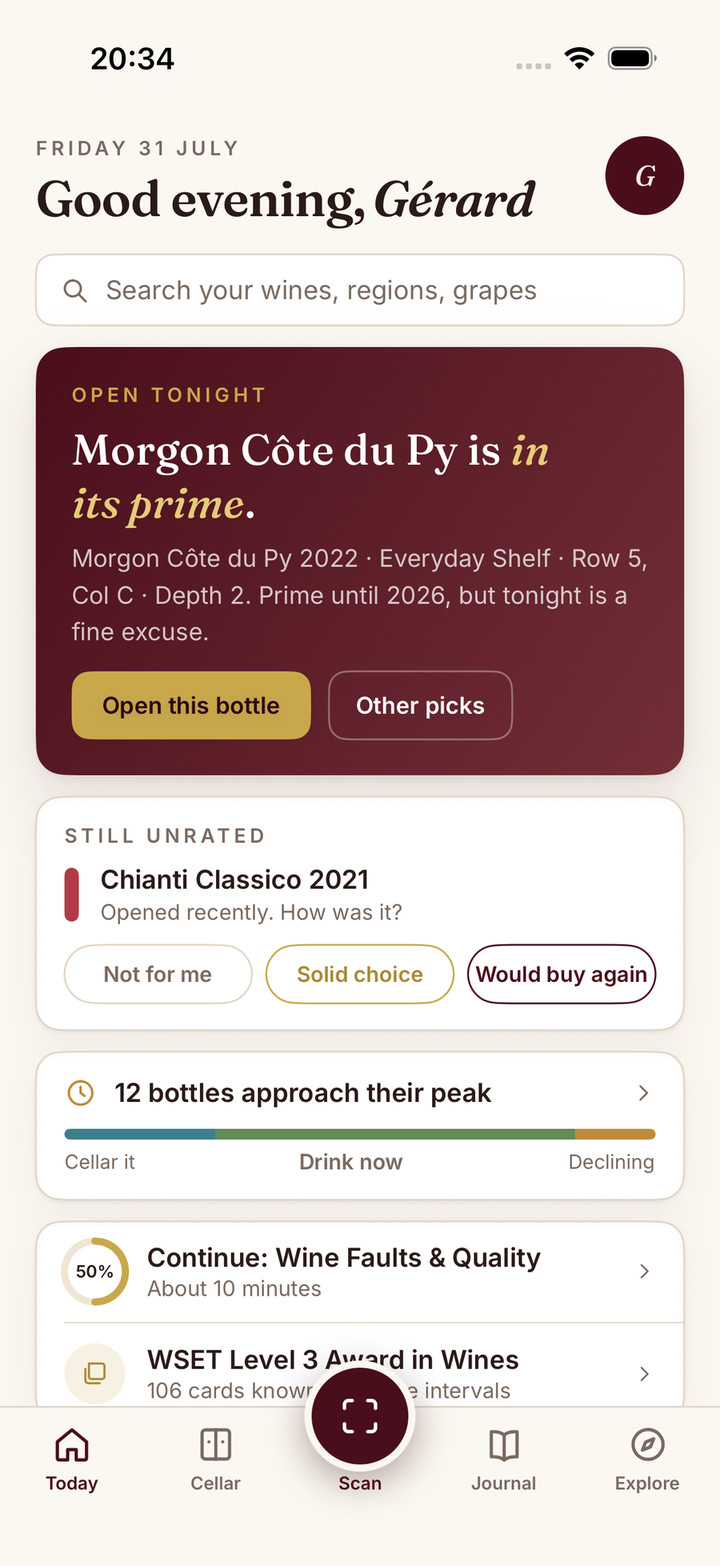
Consider the actual Tuesday problem. You have 180 bottles. Twenty are technically ready. You are cooking something specific. CellarTracker gives you a list of twenty. Wine-Searcher tells you what they cost. You still have to decide, and if you are honest, you reach for the same six wines you always reach for while the other 174 quietly age past their window.
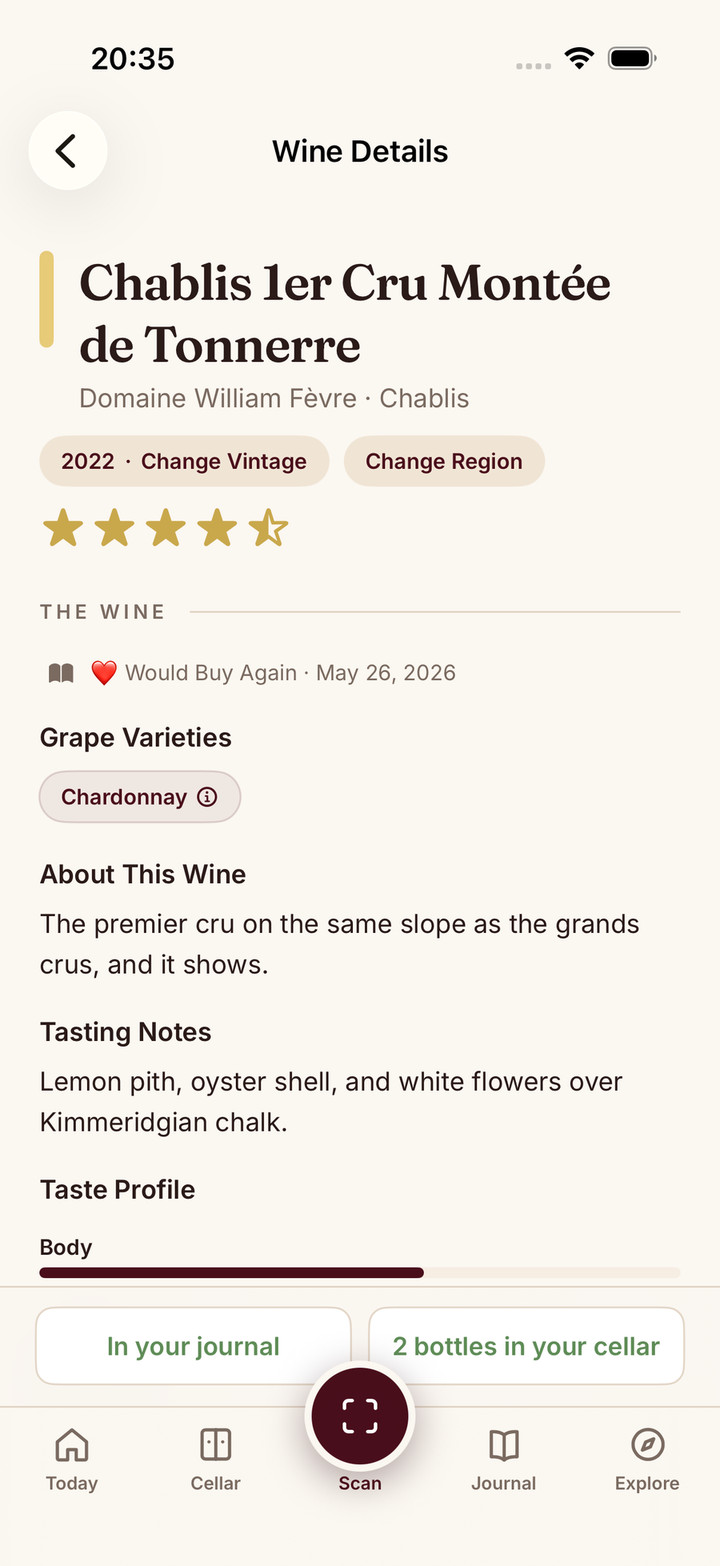
Sommo attacks that specific problem. The cellar does AI food pairing against your own bottles: describe the meal, get a specific recommendation and the reasoning behind it. Drinking windows are not a single date but the full too-young, ready, and past-peak curve, sharpened by vintage strength, storage, and your own ratings, with readiness notifications so bottles do not slip past you. Racks are a drag-and-drop grid rather than a text field, and Open Tonight ranks what is most worth drinking now.
Alongside that, the parts neither competitor attempts: SAT-structured tasting notes with AI feedback on what you missed, wine character analysis that builds a palate profile from your journal, and WSET exam prep for Levels 1 to 4.
Where it does not compete: no market valuations, no price comparison, no 14 million community notes. A collector who needs insurance-grade numbers still needs Wine-Searcher, and a collector who wants two decades of consensus on a specific vintage still wants CellarTracker.
All Three, Side by Side
| Sommo | CellarTracker | Wine-Searcher | |
|---|---|---|---|
| Core job | Drinking the collection well | Recording the collection | Pricing the market |
| Inventory | Full cellar, multi-rack grid | Unlimited, free, best in class | 25 or 500 wine cap |
| AI food pairing | Yes, from your own bottles | CellarChat, subscriber-gated | No |
| Drinking windows | Vintage, storage and palate aware, with alerts | Community consensus, best in class | No |
| Valuation | No | Yes | Live market, best in class |
| Structured tasting | SAT notes with AI feedback | Free-form community notes | Free text and stars |
| Learns your palate | Yes | No | No |
| WSET prep | Levels 1 to 4 | No | No |
| Data export | CSV and Excel, free, in app | Desktop web only | Limited |
| Platforms | iOS, Android, web | iOS, Android, desktop web | iOS, Android, web |
| Price | Free tier; Premium $5/mo or $29.99/yr | Free unlimited; $40 to $500/yr | Free limited; PRO $8.25/mo yearly |
The Bottom Line
Keep CellarTracker as the ledger. Keep Wine-Searcher as the market feed. Both are excellent, both are the best in the world at their job, and neither is going anywhere.
Then ask what those two tabs have actually done for the bottle after you buy it. If the answer is “I know what I own and what it cost, and I still open the same thing every week,” the missing piece is not more accounting. It is one app that connects the scan, cellar, dinner, journal, palate and people at the table.
Try Sommo free, or read the detail: Sommo vs CellarTracker and Sommo vs Wine-Searcher.
CellarTracker or Wine-Searcher for your collection?