Cellar apps split into two philosophies, and these two are the cleanest examples of each.
CellarTracker believes a cellar is a database. Every bottle is a row, enriched by two decades of community knowledge about what that wine does over time. InVintory believes a cellar is a place. Every bottle is a position in a physical grid you can look at, click, and rearrange.
Both are right. Which one is right for you depends entirely on which problem keeps costing you bottles.
The Short Answer
CellarTracker wins on knowledge. Unlimited free inventory, over 14 million community tasting notes, and drinking windows drawn from thousands of real openings. It has been the collector’s default since 2003.
InVintory wins on space. Visual maps of racks, bins, and fridges with drag-and-drop placement, so the app mirrors the physical cellar rather than describing it.
| CellarTracker | InVintory | |
|---|---|---|
| Philosophy | The cellar is a database | The cellar is a place |
| Inventory | Unlimited, free | Structured around physical layout |
| Visual rack map | Location as text data | Yes, the core feature |
| Community notes | 14m plus, best in class | None |
| Drinking windows | Community consensus | Estimates |
| AI features | CellarChat, subscriber-gated | None |
| Food pairing | No | No |
| Education | No | No |
| Interface | Redesigned apps, desktop-heavy power features | Modern, purpose-built |
CellarTracker pricing as of mid-2026 runs from a genuinely free unlimited tier up to roughly $40 to $500 a year by bottle count. InVintory publishes its own plans and has revised them over time, so check its current pricing before committing.
What CellarTracker Is Best At
Institutional memory. When you add a wine to CellarTracker you inherit everything the community knows about it: how the 2016 showed at five years, whether the 2018 needs another decade, whether a producer had an off vintage everyone quietly agrees about.
That is over 14 million tasting notes, written disproportionately by people who own the wine rather than people who tasted it once at a trade fair. For anyone buying to age, that archive is the product. The drinking windows follow from it, and consensus built on real openings beats a single formula.
The inventory is serious too, and free without limit. Bottle counts, purchase prices, locations as data, valuations.
The cost is the era it was built in. The mobile apps have been redesigned, but the power features and data export still live on a desktop website that looks its age, and adding wines is mostly typing rather than scanning. It rewards patience.
What InVintory Is Best At
Answering “where is it?” without walking to the cellar.
InVintory lets you build a visual model of your storage: racks, bins, fridges, with their real shapes and slot counts, and then drag wines into specific positions. Open the app and you see the layout, not a list. For someone with a temperature-controlled unit and 300 bottles arranged with intent, that is the difference between a working system and a spreadsheet you stopped updating.
It also handles the fundamentals: drinking window estimates and basic tasting notes, wrapped in a clean, modern interface that does not feel like homework.
The cost is everything outside that focus. There is no community database, no meaningful tasting archive, no AI features, no food pairing, and no learning content. It is a pure inventory tool, and a deliberately niche one. If you do not have structured physical storage, much of the value proposition evaporates.
Head to Head
Finding a Specific Bottle
InVintory. This is the whole reason it exists, and it does it better than anything else.
Knowing Whether to Open It
CellarTracker. Community drinking windows from thousands of real openings are simply more informative than a generic estimate. If you buy wine to age, this is the deciding feature.
Getting Wines In
Neither is fast. CellarTracker leans on database search and typing. InVintory leans on manual entry plus placement. Compared with scan-first apps, both feel like data entry, and both have a long tail of half-populated accounts because of it.
Tasting Notes
CellarTracker, comprehensively. InVintory’s notes are basic by design. But note that CellarTracker’s depth is community depth, not personal structure: you still write into an empty box, with no framework and no feedback, so your own notes accumulate as text rather than as skill.
Cost
CellarTracker’s free unlimited tier is the most generous offer in wine software and hard to argue with. InVintory’s value depends on whether the visual layout solves a problem you actually have.
Deciding What to Drink Tonight
Both hand you a list and step back. Neither will look at what you are cooking and pick from your own bottles. CellarChat can answer questions about your collection on paid tiers, which is closer than InVintory gets, but it is still a chat rather than a recommendation grounded in your racks and tonight’s meal.
Who Should Pick CellarTracker
You buy wine to age. You care about consensus on vintages. You want an archive that outlives your phone, and you do not mind that the serious work happens on a laptop. The free tier will carry you indefinitely.
Who Should Pick InVintory
You have invested in real storage and you want a digital twin of it. You lose more time hunting bottles than you lose bottles to bad timing. You value a modern interface highly enough to trade away the community archive.
What Both Are Missing
Here is the thing neither philosophy addresses: a cellar is not an end in itself.
Nobody collects wine in order to have accurate records of wine. They collect it to drink well. Yet both apps stop at the inventory boundary. You end up with a perfect map or a perfect database, and the same six habitual bottles in rotation while the rest ages quietly past its window.
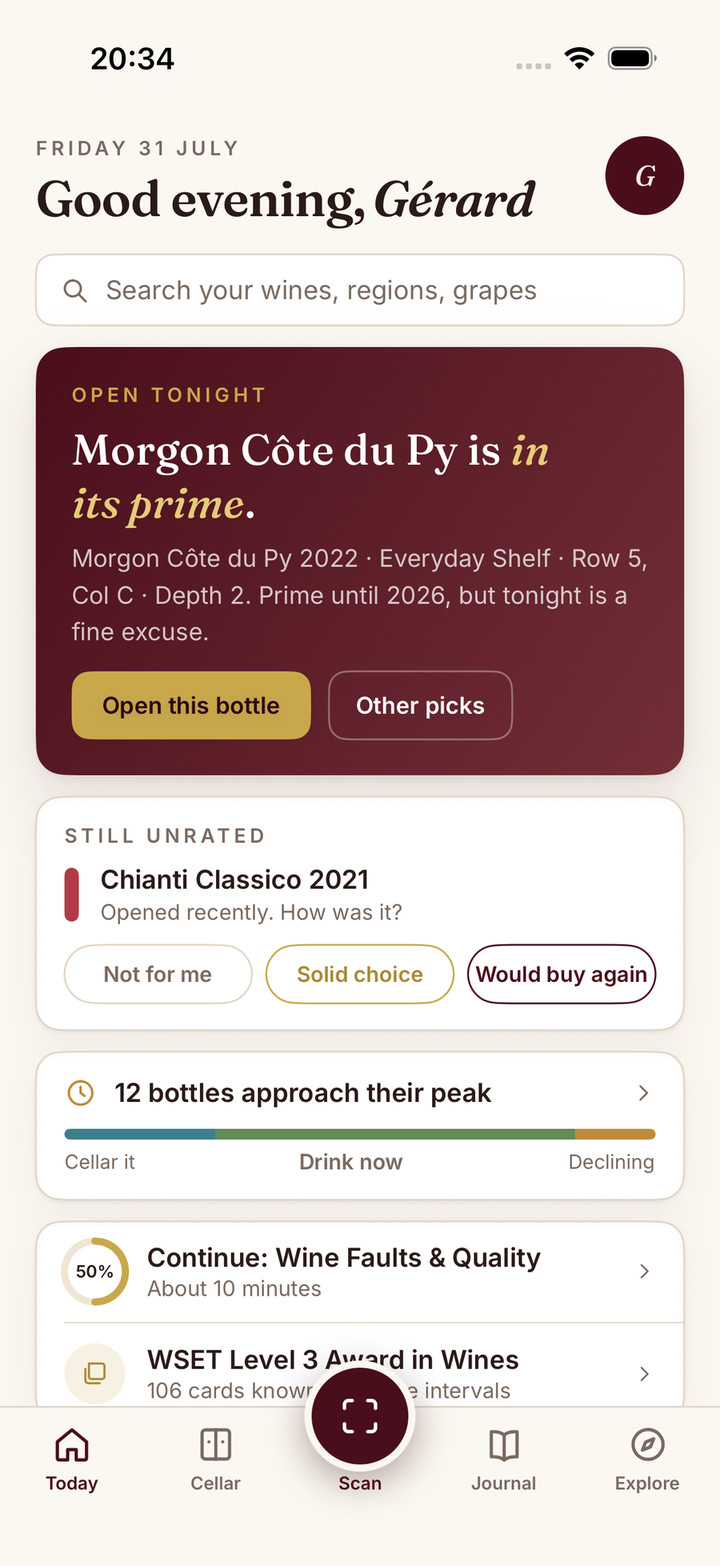
Sommo’s cellar was built from the other end. It has the visual layer: multiple named racks in a drag-and-drop grid, with depth-aware positions, so it maps the physical cellar the way InVintory does. It has drinking windows that go past a single date into the full too-young, ready, and past-peak curve, weighted by vintage strength, storage conditions, and your own ratings as you drink, with readiness notifications so bottles do not slip by.
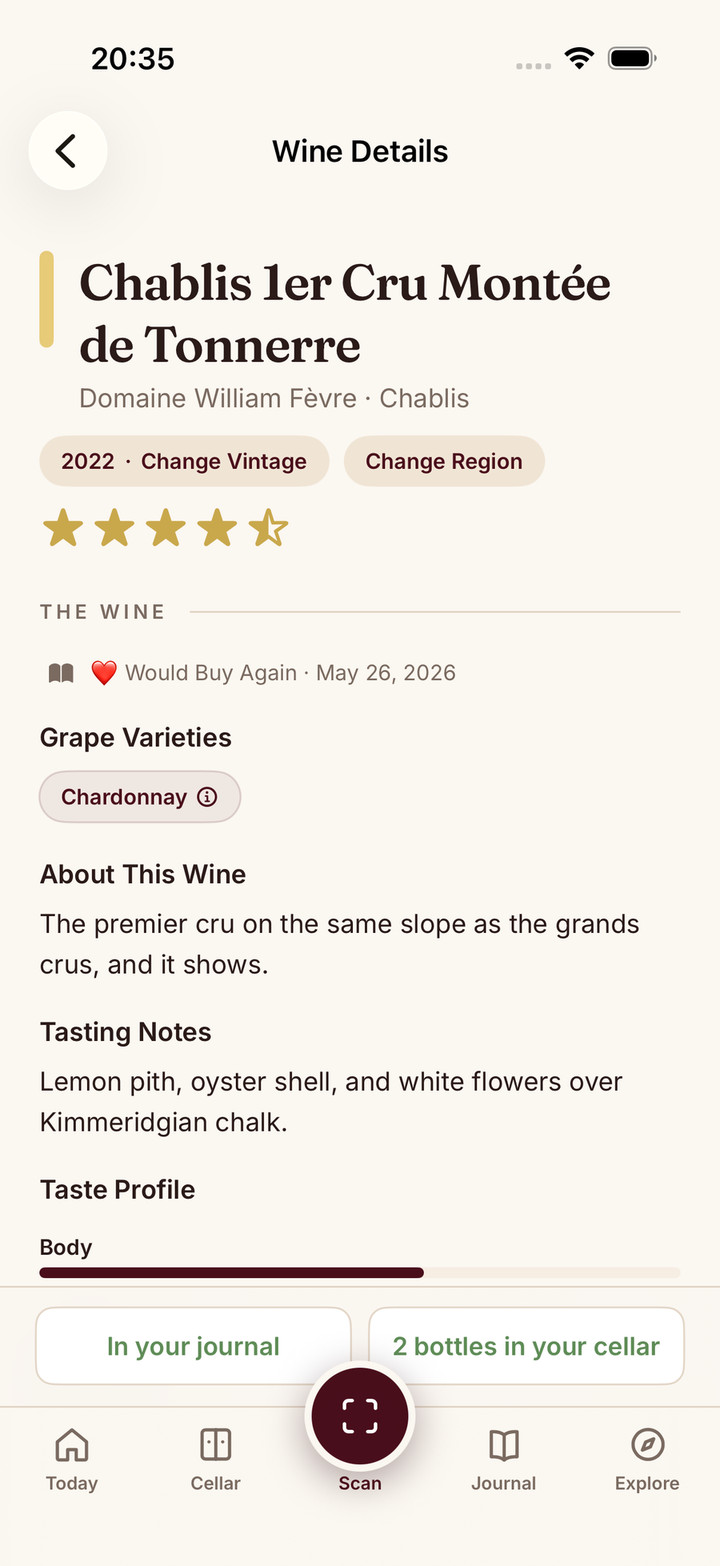
Then it does the part neither competitor attempts. Describe tonight’s meal and the AI picks from the bottles you actually own, with the reasoning. Open Tonight ranks what is most worth drinking now by readiness. SAT-structured tasting notes come back with AI feedback on what you caught and missed. Character analysis turns the journal into a palate profile. WSET prep for Levels 1 to 4 lives in the same app. CSV and Excel export are free and in the app rather than exiled to a desktop site.
Where it does not compete: there is no 14 million note community archive, and there never will be quickly. A collector who wants twenty years of consensus on a specific Barolo vintage should keep CellarTracker open. That is a fair trade to state plainly.
All Three, Side by Side
| Sommo | CellarTracker | InVintory | |
|---|---|---|---|
| Visual rack map | Multi-rack drag-and-drop grid | Location as text | Best in class |
| Inventory scale | Full cellar, Premium | Unlimited, free, best in class | Structured by layout |
| Community notes | No | 14m plus, best in class | No |
| Drinking windows | Vintage, storage and palate aware, with alerts | Community consensus | Estimates |
| AI food pairing | Yes, from your own bottles | CellarChat, subscriber-gated | No |
| Label scanning | AI scan straight to cellar | Limited | Manual |
| Structured tasting | SAT notes with AI feedback | Free-form community notes | Basic |
| Education | Learning modules and WSET 1 to 4 | No | No |
| Data export | CSV and Excel, free, in app | Desktop web only | Check current plans |
| Platforms | iOS, Android, web | iOS, Android, desktop web | Mobile-first |
| Price | Free tier; Premium $5/mo or $29.99/yr | Free unlimited; $40 to $500/yr | See current plans |
The Bottom Line
If your problem is “I do not know what this wine will do,” use CellarTracker and use it free. If your problem is “I do not know where this wine is,” use InVintory, because it was built for exactly that.
If your problem is “I own good wine and I am not enjoying it as well as I should,” neither map nor database solves the whole thing. A cellar that also chooses for dinner, remembers the pour, builds Taste DNA and joins a shared tasting is a different kind of app.
Try Sommo free if you want that cellar inside one connected wine life, or read Sommo vs CellarTracker.
You can also compare the visual-cellar approach directly in Sommo vs InVintory.
CellarTracker or InVintory for your cellar?