The estimate looks affordable. The next bid is only a little higher. Then the invoice adds premiums, tax and the cost of getting the wine home. Before bidding, check the exact lot and work backwards from the most you will pay in total. If important costs remain unknown, you do not yet have a defensible maximum bid.
This is a buyer’s process for wine you intend to drink. A catalogue description, a good storage story and an attractive price can inform the decision; none guarantees authenticity, sound bottles or future value.
First decide whether you want this whole lot
Write down producer, cuvée, vintage, bottle size and quantity. Eight bottles in a twelve-bottle wooden case are still eight bottles. Check every component of a mixed lot, and ask about anything the title leaves ambiguous. The relevant comparison is another offer for the same wine, size and condition, with its own delivery costs included.
Read photographs and condition notes together. Look for fill levels, seepage, cork or capsule observations and label damage, then ask what has actually been inspected. A photograph of the front labels cannot answer every question about storage. Our inherited collection guide explains the inventory discipline from the other side of the transaction.
Christie’s provenance explanation, checked on 16 October 2026, describes the importance of acquisition history, storage records and inspection. Treat gaps as unanswered questions. “Professional storage” needs a period and a documented chain; it does not explain every previous year of a mature bottle’s life.
The ullage recording guide helps you ask comparable fill-level questions without turning a visible level into a certificate of quality.
A real lot, checked at a desk
On 16 October 2026, Sotheby’s London Finest & Rarest Wines, 14 to 28 October 2026, listed lot 1, Château Talbot 1982, eight bottles. The catalogue records two bottom-neck levels, soiled labels, one slightly scuffed label and one wine-stained label, packed in a twelve-bottle original wooden case. It states Octavian storage and an offer in bond, available duty paid. These are catalogue statements; we have not inspected the bottles or accessed the signed-in condition report.
The lot page gives a 24% buyer’s premium plus 1% overhead premium, before applicable taxes. The premium chart, rates dated 13 February 2026, independently matches those wine-and-spirits rates.
For a hypothetical £1,000 hammer price, that means £240 buyer’s premium and £10 overhead premium: £1,250 before tax, duty, delivery and other applicable costs. It is not an all-in price, a current bid or a prediction of the result. The sale may have closed by the time you read this; recheck the current lot and terms.
Sotheby’s buyer tax guide, updated 13 September 2026, distinguishes the filled diamond for wine in bond available duty paid from the hollow diamond for in-bond-only lots. Taxes can apply to different parts of the invoice. Ask the sale team for the treatment of your particular lot and destination; “25% fees” does not settle the tax bill.
Build the actual-fee worksheet
Use the sale’s current conditions, not a remembered rate from another auction. Keep a written quote or source beside each number. A blank is unresolved, not zero.
| Cost or condition | Your confirmed entry |
|---|---|
| Total budget, currency and destination | ______ |
| Lot identity, size and bottle count | ______ |
| Buyer’s premium: rate and calculation | ______ |
| Overhead or other sale fee | ______ |
| Tax: rate, base and bond treatment | ______ |
| Duty, clearance and import costs | ______ |
| Shipping, transit cover and handling | ______ |
| Storage until collection; deadline | ______ |
| Payment/currency costs | ______ |
| Permitted bid increments | ______ |
| Maximum hammer after calculation | ______ |
Confirm the payment deadline, accepted method, collection arrangements and when storage charges begin. Read the sale’s condition-report, cancellation and returns provisions before relying on an ordinary retail experience. Ask what happens if a lot arrives with a discrepancy or a bottle proves unsound, and which notification period applies. Save the answer outside your cellar inventory.
Work back, then round down
Where every variable charge is genuinely proportional to hammer price, a useful expression is:
Maximum hammer = (total budget − confirmed fixed costs) ÷ confirmed hammer multiplier.
If fees are tiered, capped or taxed differently, calculate each candidate bid using the actual schedule instead. The simple expression will not represent every sale. Round down to a permitted bid and recalculate its complete invoice; never round up merely to reach the next increment.
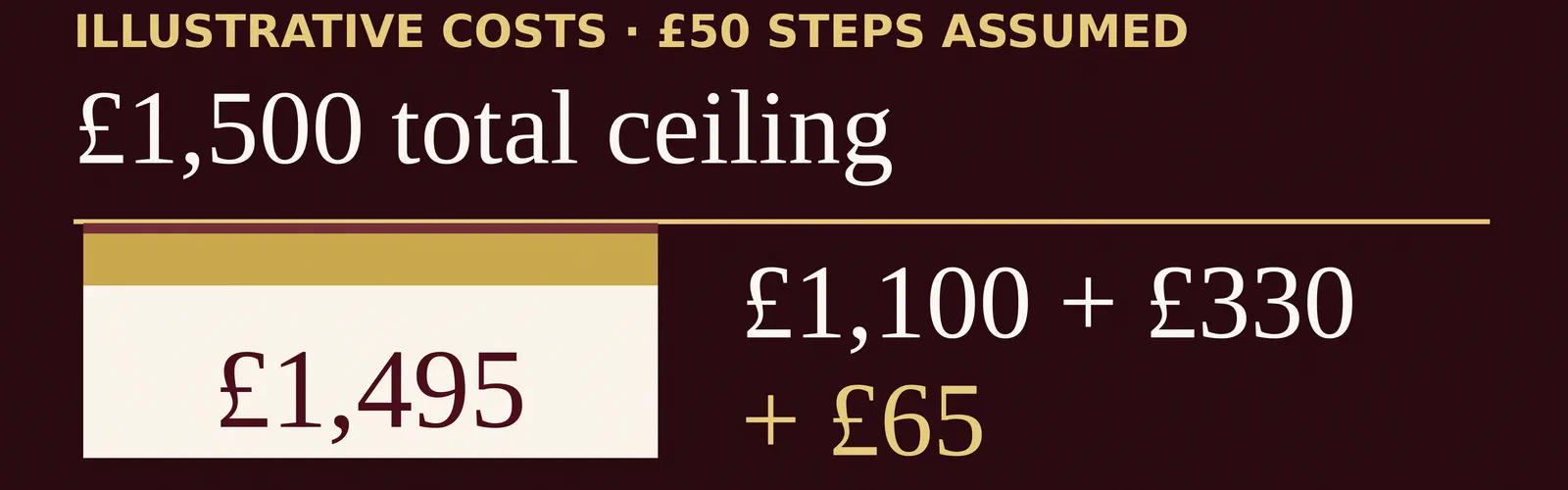
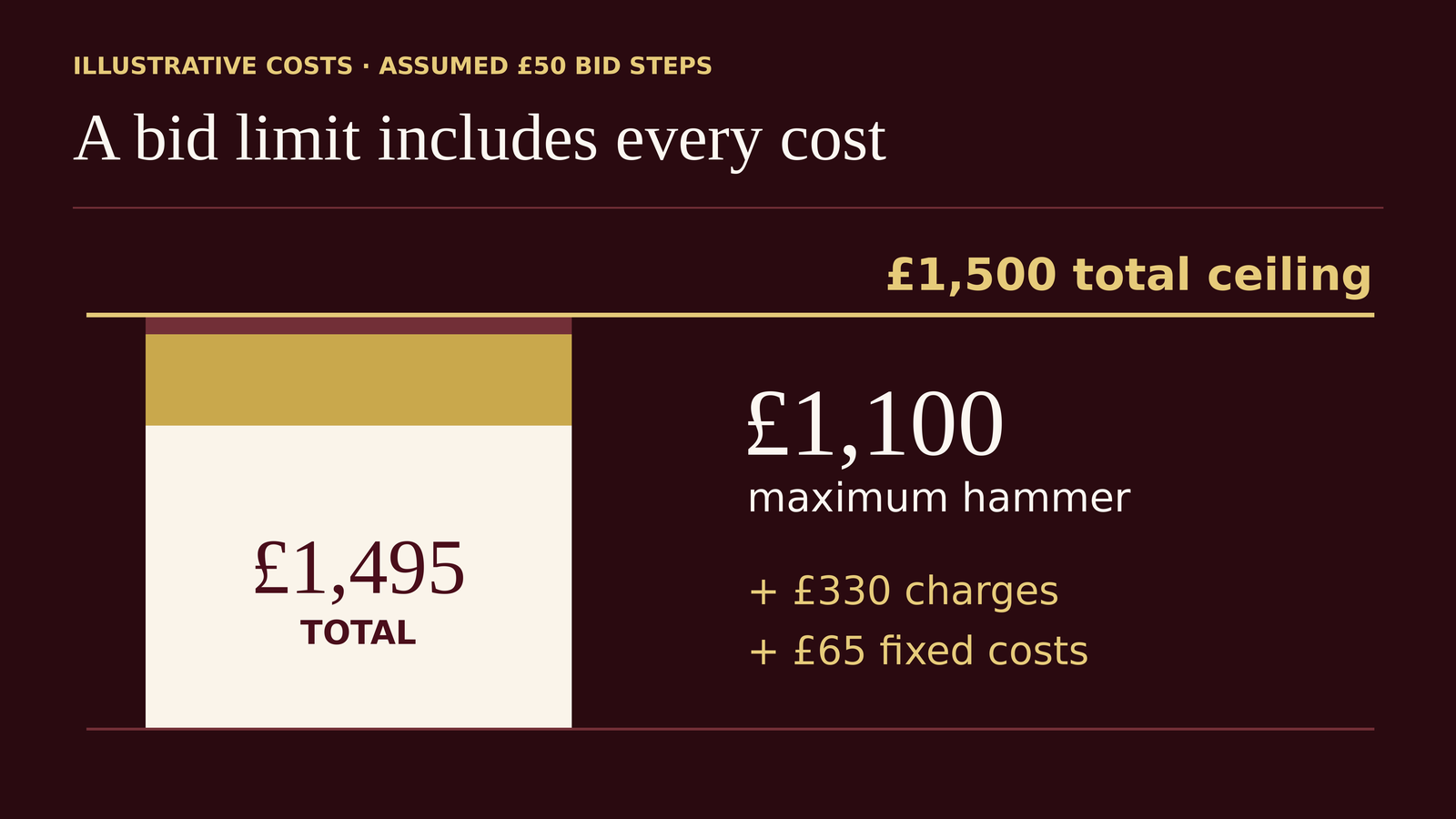
Synthetic arithmetic exercise, unrelated to the Talbot lot: suppose an auction has confirmed a complete multiplier of 1.30, including all proportional charges for this buyer, and £65 of fixed delivered costs. With a £1,500 total budget, (£1,500 − £65) ÷ 1.30 = £1,103.85. If that sale permits £50 steps in this range, the cap is £1,100. Its total is £1,100 × 1.30 + £65 = £1,495. The next £1,150 step costs £1,560, exceeding the budget by £60. Every rate and cost in this exercise is assumed, not a Sotheby’s quote.
For the checked real lot, we have not resolved a particular buyer’s tax, duty, transit cover, storage and final delivery bill. The worksheet therefore supports questions, not an all-in bid recommendation. Divide a confirmed total by the actual bottle count only after those costs are known, and remember that a mature lot may include bottle variation.
If you are also selling bottles to fund the purchase, use the separate collection sale dossier to compare the seller’s net proceeds rather than an auction estimate.
Once the purchase is settled, Sommo’s cellar can record the bottles and quantities you actually own. Keep invoices, provenance documents and the auction agreement in your own document store. Sommo does not bid for you, authenticate the lot or attach those documents as an auction dossier.