The six-bottle price looks better. Your cupboard already contains eight bottles, you have only tried an earlier vintage, and two wines in the mixed case do not appeal. Those details can matter more than the discount.
Buy one bottle when you need to learn whether you like that exact wine. Buy several of the same wine when you have tasted the vintage, have a realistic use for the quantity and can store it properly. Choose a mixed case when its actual contents fit your interests. In every case, compare the delivered total before the price per bottle.
The right purchase fills a gap in the wine you already own. It does not create a deadline to drink more.
Read the offer, not just the headline
A “case” might contain six bottles or twelve, one wine or several, and standard bottles or another format. Write down the number, bottle size, exact wines and vintages before comparing totals.
As a dated real example, Majestic’s Mix Any Six page, inspected on 16 October 2026, says that buying six bottles or more, mixed or the same wine, qualifies for the offer where it applies. Its comparison is against its single-bottle price. That establishes the offer’s structure, not whether a particular basket is the cheapest way to obtain those wines.
The retailer’s terms, checked the same day, distinguish geography-dependent pricing and say the website defaults to England pricing. They also explain that prices include VAT and delivery is additional. Use the price and eligibility shown for your actual delivery or collection location. Recheck the terms and final basket when buying; this is not a live quotation.
A discount compared with one retailer’s own single-bottle price also need not beat another retailer’s delivered offer. Compare like-for-like wine, vintage and size, then include the costs needed to get it home.
Put three offers on one worksheet
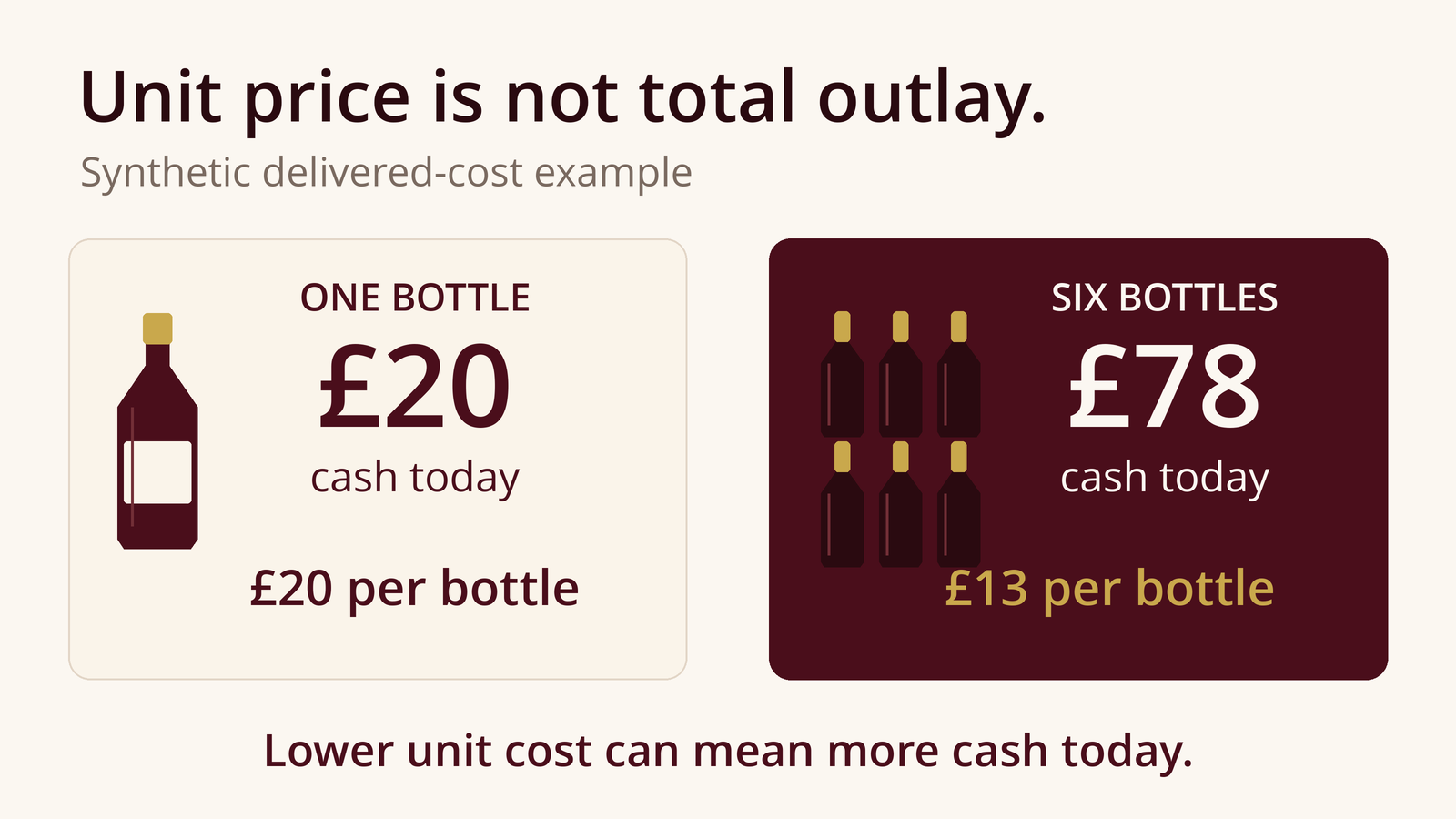
These are synthetic offers, created to show the arithmetic. They are not Majestic prices or recommendations to buy a particular quantity. Assume all bottles are 750ml, prices include tax, and there are no other fees.
| Offer | Delivered calculation | Delivered unit cost |
|---|---|---|
| A: one bottle | £15 + £5 delivery = £20 | £20 ÷ 1 = £20 |
| B: six of one wine | 6 × £12 + £6 delivery = £78 | £78 ÷ 6 = £13 |
| C: six mixed wines | £66 + £6 delivery = £72 | £72 ÷ 6 = £12 |
Offer B lowers the unit cost by £7 against A, while requiring £58 more cash today. Those figures answer different questions. If you only want to try the wine, spending £20 can be the sensible decision despite its higher unit price.
Suppose you actively want only four bottles in offer C. If you conservatively assign no personal value to the other two, £72 ÷ 4 is £18 per wanted bottle. You still receive six bottles; this is a planning calculation, not a retail unit price. Gifts can have value, but only count them if you have recipients and occasions in mind rather than treating unwanted stock as imaginary savings.
Copy the worksheet for real offers:
| Check | Your figures |
|---|---|
| Exact wines, vintages, sizes and quantities | ______ |
| Bottle subtotal less valid discounts | £______ |
| Delivery and other unavoidable charges | £______ |
| Total / all bottles | £______ / ______ = £______ |
| Bottles you actually want / cost per wanted bottle | ______ / £______ |
| Stock already owned / suitable space available | ______ / ______ |
| Final decision and reason | ______ |
For wider delivery checks, use our wine delivery ordering guide. Collection may change the calculation, but include the journey if it adds a meaningful cost.
When repeating one wine earns its place
A same-wine case is easiest to justify when you already know that exact vintage and intend to revisit it over time. A favourite producer’s new release may differ from the bottle you enjoyed last year. If the merchant lists “2023/24”, confirm which year will arrive before treating it as a repeat purchase.
Count what you own first. Four similar bottles already in storage plus a case of six means ten bottles serving much the same purpose. Ask which meals, gifts or future comparisons those bottles cover, without turning occasions into a consumption target.
Repeated bottles can support a useful comparison at different dates, but only if the wine and storage suit that plan. A discount does not establish ageing potential. Our first real cellar guide helps place repeat purchases within a broader collection.
When a mixed case is useful
A mixed case can spread discovery across styles without committing to six copies of an unfamiliar wine. Read the bottle-by-bottle list rather than relying on “discovery”, “premium” or “worth £120”. Check how many repeats it contains and whether the included styles match what you want to explore.
Then ask about substitutions. Can the merchant change a vintage, producer or wine? Can you decline a substitute, and what happens to the order or offer price? Majestic’s current terms, for example, discuss insufficient-stock cancellation when substitutions have not been opted into. That does not tell you the substitution policy of another seller.
If the named bottle is the reason you want the case, obtain confirmation before paying. Save the contents and terms with your order record so a changed delivery can be checked accurately.
Separate an introductory case from a subscription
Before accepting an attractive first-box price, check whether the purchase starts recurring deliveries or payments. Record the next price, frequency, minimum commitment, notice deadline, cancellation method and whether promotional savings depend on continuing.
Do not use the introductory price as the cost of every future box. Compare the full commitment you are considering, including delivery and bottles you would not independently choose. If the future charge or exit process remains unclear, the decision remains unresolved.
Check the space before checking out
Suitable storage means more than six empty positions on a diagram. Check actual bottle shapes, shelf limits and the conditions in the real location. A digital inventory cannot confirm the cabinet’s physical fit or temperature.
Sommo’s wine cellar can help you check the bottles and quantities already recorded before you order. Reconcile that record with the shelf, then write the intended arrivals into your buying plan. Buy the quantity that fits your needs, storage and budget; a higher unit price can be a fair price for keeping the commitment small.