Best WSET Revision Apps 2026: Flashcards, Mock Exams & AI Study Plans
Comparing the best apps and tools for WSET exam preparation in 2026. From spaced repetition flashcards to AI study plans, find the revision method that works.
There’s a moment in every WSET student’s journey where the sheer volume of material hits you. You’re staring at a page listing the permitted grape varieties of Châteauneuf-du-Pape, trying to remember whether Counoise is red or white, and wondering how anyone retains all of this.
I’ve been there. The WSET syllabus covers hundreds of grape varieties, dozens of regions, winemaking techniques, labelling laws, and a tasting framework you need to internalise until it becomes second nature. The official study materials are excellent, but reading and re-reading the textbook only gets you so far. At some point, you need active recall. You need to test yourself.
That’s where revision apps come in. I’ve spent real time with every major option, from purpose-built WSET tools to general flashcard platforms. Here’s what actually works, what wastes your time, and what’s worth your money.
What Makes a Great WSET Revision App?
Before comparing tools, it helps to know what matters. Not every flashcard app is equal when it comes to wine exam prep.
WSET-aligned content. The questions and cards need to match the actual syllabus. Generic wine trivia won’t help you pass. You need content mapped to Level 1, Level 2, Level 3, or Level 4 specifically.
Spaced repetition. This is the single most effective study method for factual recall. Instead of reviewing everything equally, a spaced repetition system shows you cards you’re about to forget, right before you forget them. Medical students have used this technique for years. It works.
Mock exams. Knowing the material isn’t the same as performing under exam conditions. Timed mock exams build the speed and confidence you need on the day.
Adaptive learning. The best tools identify your weak spots and push you towards them. If you keep getting Alsace questions wrong, the app should notice and adjust.
Portability. WSET revision happens in stolen moments: on the train, in a queue, during lunch. If the tool isn’t on your phone and fast to open, you won’t use it consistently.
With those criteria in mind, here’s how the options compare.
1. Sommo — Best Dedicated WSET App
Best for: Students who want a single app purpose-built for WSET revision across all levels.
Sommo is the only app I’ve found that’s built from the ground up for WSET exam preparation. It isn’t a general flashcard tool with wine content bolted on; the entire WSET exam prep feature is structured around the syllabus.
The flashcard decks use the SM-2 spaced repetition algorithm, the same system behind Anki and the tools medical students rely on to memorise thousands of facts. Cards are pre-built for each WSET level, so you don’t have to spend weeks creating your own. They cover grape varieties, regions, winemaking, labelling laws, and everything else the syllabus throws at you.
The mock exams are where Sommo genuinely stands apart. Timed 50-question tests simulate the real exam format, complete with the pressure of a countdown clock. After each attempt, you get explanations for every question. That feedback loop matters more than most people realise.
Then there’s the AI study plan. It analyses your quiz scores, flashcard performance, and wrong answers to build a revision schedule that focuses on your weak areas. If you’re solid on Bordeaux but shaky on the Rhône, the plan adapts. This is the kind of feature that saves you hours of guessing what to revise next.
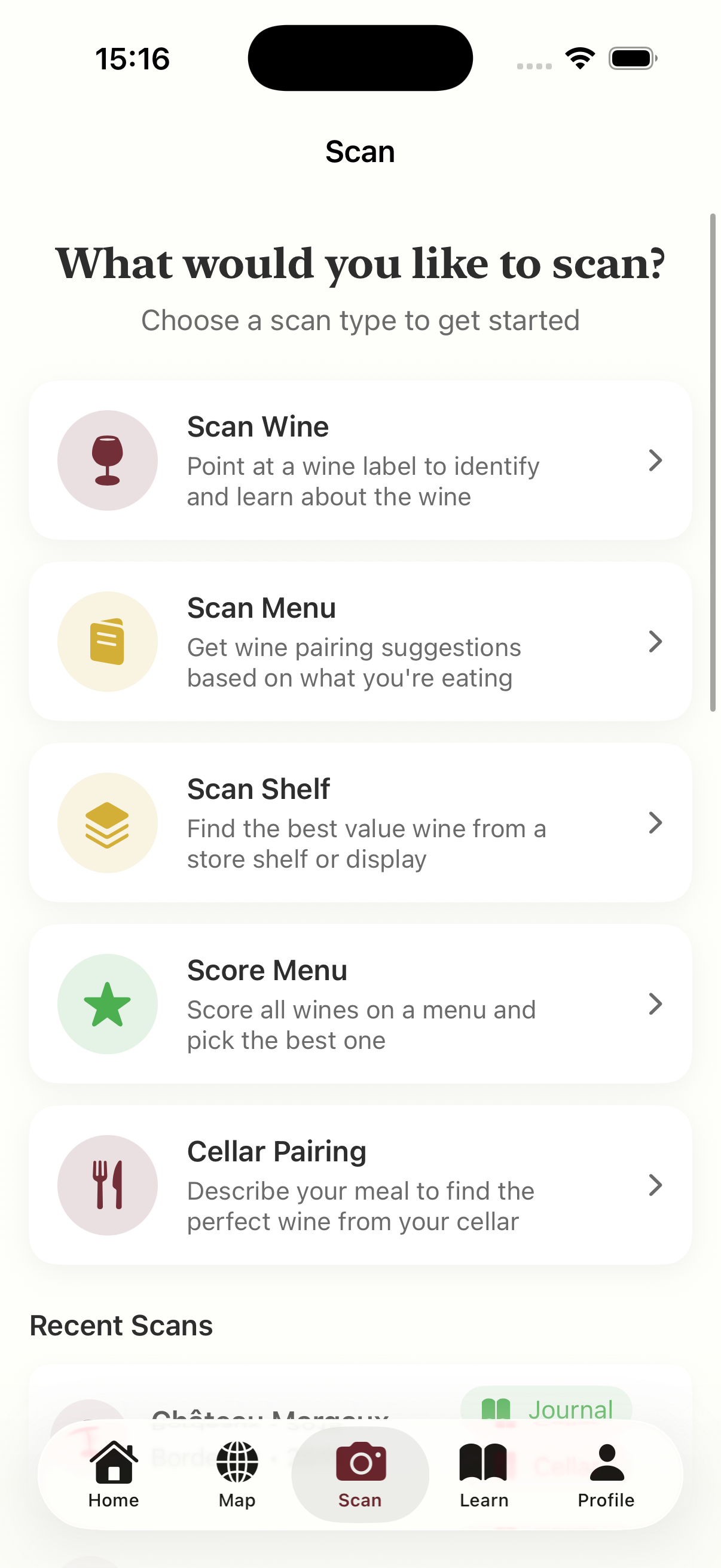
Beyond exam prep, Sommo also has label scanning, a wine journal, and a wine region map for exploring regions visually. That last part is surprisingly useful for WSET: you can practise locating the regions you’re studying, which reinforces the geography the syllabus tests you on.
The cheatsheets for each level are another thoughtful touch. They’re interactive, track your progress, and give you a condensed reference for quick revision sessions.
Strengths:
- Purpose-built for WSET Levels 1 through 4
- SM-2 spaced repetition flashcards, pre-built for each level
- Timed mock exams that mirror the real format
- AI study plans that adapt to your weak areas
- Interactive cheatsheets with progress tracking
- Bonus features (label scanning, journal, region map) let you practise what you study
Weaknesses:
- iOS only for now (no Android or web version)
- Full content requires a Premium subscription
- Relatively new compared to established platforms
Price: Free for Level 1 content. Premium unlocks all levels at $4.99/month or $29.99/year, with a 3-day free trial.
Verdict: If you want one app that handles flashcards, mock exams, and study planning for WSET specifically, Sommo is the strongest option available. Read more about the full feature set at Sommo for WSET students.
2. Brainscape — Best General Flashcard App for Wine
Best for: Students who want a polished flashcard experience and don’t mind hunting for quality decks.
Brainscape is a well-designed flashcard platform with a confidence-based repetition system. You rate each card from 1 to 5 based on how well you know it, and the app adjusts how often it appears. It’s not as mathematically rigorous as SM-2, but it’s intuitive and effective enough.
The platform has community-created WSET decks you can browse and study. Some are genuinely good. Others are incomplete, outdated, or contain outright errors. The quality problem is real: I’ve seen Level 2 decks that mix in Level 3 content, and decks that list incorrect appellations. You need to vet what you’re studying.
If you create your own decks, Brainscape is excellent. The interface is clean, the repetition engine works well, and the mobile app is fast. But making your own cards is a significant time investment that not every student can afford alongside an already demanding syllabus.
Strengths:
- Clean, modern interface
- Confidence-based repetition works well in practice
- Large library of community decks to browse
- Creating your own cards is straightforward
Weaknesses:
- Community WSET decks vary wildly in quality and accuracy
- No mock exams, no timed tests
- No wine-specific features (no scanning, tasting, or region maps)
- Pro subscription needed for unlimited decks ($9.99/month)
Price: Free with limited decks; Pro at $9.99/month for full access.
Verdict: A solid flashcard tool if you’re willing to create your own content or carefully vet community decks. Best used as a supplement alongside other resources rather than your primary revision tool.
3. Anki — Best for Self-Motivated Power Users
Best for: Students who want full control over their revision system and don’t mind a learning curve.
Anki is the gold standard of spaced repetition software. It’s open-source, endlessly customisable, and the algorithm behind it has decades of research backing it up. If you’re the kind of person who enjoys tweaking settings and building systems, Anki will reward that investment.
Shared WSET decks exist on AnkiWeb, and the same quality warning applies here as with Brainscape. Some decks are superb; others are riddled with errors or cover only fragments of the syllabus. The best Anki users tend to create their own cards as they study, which is itself a form of active learning.
The trade-off is usability. Anki’s interface is functional rather than friendly. Syncing between devices requires an AnkiWeb account. The desktop app is free, but the official iOS app is a one-time $24.99 purchase, which surprises people used to subscription-based pricing. On the bright side, once you’ve paid, it’s yours forever.
Strengths:
- Best-in-class spaced repetition algorithm
- Completely free on desktop; one-time purchase on iOS
- Endlessly customisable (card types, intervals, styling)
- Huge community of shared decks across all subjects
Weaknesses:
- Steep learning curve for setup and customisation
- No wine-specific features whatsoever
- No mock exams, no adaptive study plans
- Interface feels dated compared to modern apps
- Quality of shared WSET decks is inconsistent
Price: Free on desktop and Android. $24.99 one-time on iOS.
Verdict: If you already use Anki for other studying and want to add WSET to your system, it makes perfect sense. If you’re starting from scratch and just want to revise for WSET, the setup cost probably isn’t worth it when purpose-built alternatives exist.
4. Wine Scholar Guild — Best for Professional Wine Certifications
Best for: Students pursuing CWE, FWS, IWS, or SWS certifications rather than WSET.
Wine Scholar Guild offers deep-dive courses on French, Italian, and Spanish wines, plus their own Certified Wine Expert programme. The content is exceptional, written by genuine authorities, and the depth goes well beyond what most resources offer.
The catch is that none of it is aligned to the WSET syllabus. There’s overlap in topics (you’ll learn about Burgundy, Barolo, and Rioja in both), but the structure, emphasis, and exam format are completely different. If you’re studying for WSET Level 3, a Wine Scholar Guild course won’t map to what you’ll be tested on.
It’s also significantly more expensive. Courses start at around $400 and go up from there. And it’s web-based, not a mobile app, so quick revision on your phone isn’t really an option.
Strengths:
- Exceptional depth and quality of wine education content
- Written by respected wine scholars and educators
- Excellent for CWE, FWS, IWS, and SWS certifications
- Strong community and instructor support
Weaknesses:
- Not aligned to the WSET syllabus at all
- Expensive ($400+ per course)
- Web-based only, no dedicated mobile app
- Overkill if your goal is purely WSET exam revision
Price: $400+ per course.
Verdict: Brilliant for professional wine education, but not the right tool if you’re specifically revising for WSET exams. If you’ve already passed WSET and want to go deeper into specific wine regions, this is where you’d look next.
5. Quizlet — Best Free Option for Basic Flashcards
Best for: Students on a tight budget who want simple flashcard functionality.
Quizlet is one of the most widely used study platforms in the world, and searching “WSET Level 2” or “WSET Level 3” returns plenty of community-created sets. The interface is clean and intuitive, and getting started takes seconds.
The issue is depth. Quizlet doesn’t use true spaced repetition by default; it shuffles cards randomly unless you use their “Learn” mode, which is a more recent addition and less sophisticated than SM-2. There are no mock exams, no adaptive study plans, and no wine-specific features of any kind.
For quick, free revision when you’re just starting out, Quizlet does the job. But it hits a ceiling fast, especially as you move to Level 3 and beyond where the volume and complexity of material demands a more structured approach.
Strengths:
- Free to use with a generous free tier
- Clean, intuitive interface
- Large library of community WSET flashcard sets
- Easy to create and share your own sets
Weaknesses:
- No true spaced repetition by default
- No mock exams or timed tests
- No wine-specific features
- Community deck quality varies (a recurring theme)
- Ads on the free tier
Price: Free with ads; Quizlet Plus at $3.33/month removes ads and adds some features.
Verdict: A decent free starting point, but you’ll likely outgrow it before your exam date. Fine for Level 1 basics; insufficient as a sole tool for Level 2 and above.
Which Tool for Which Level?
Not every student needs the same setup. Here’s a practical guide based on where you are.
WSET Level 1: The syllabus is manageable enough that almost any flashcard tool works. Quizlet’s free tier or Sommo’s free Level 1 content will cover you. Don’t overthink it at this stage.
WSET Level 2: This is where spaced repetition starts to matter. The jump in grape varieties and regions is significant, and you need a system that prioritises what you’re struggling with. Sommo or Anki with quality decks are your best options. For a full study strategy, see how to pass WSET Level 2.
WSET Level 3: Mock exams become critical. The Level 3 theory paper requires you to write structured answers under time pressure, and the multiple-choice section demands speed. Sommo’s timed mocks and AI study plans are designed for this. Pair it with the official study materials and The World Atlas of Wine.
WSET Level 4: At Diploma level, you need everything: deep flashcard coverage, extensive mock practice, and ideally an adaptive system that identifies gaps across a massive syllabus. No single app replaces a good study group at this level, but Sommo’s Level 4 content provides the structured revision component.
The Bottom Line
There’s no shortage of ways to make digital flashcards for WSET. The question is whether you want to spend your limited study time building and vetting content, or whether you want to open an app and start revising immediately with material you can trust.
For general flashcard power users who already have a system, Anki remains unbeatable on flexibility. For students who want a free starting point, Quizlet and Brainscape both work. For those pursuing non-WSET wine certifications, Wine Scholar Guild is in a league of its own.
But for WSET exam preparation specifically, with syllabus-aligned flashcards, realistic mock exams, and AI-driven study plans that adapt as you learn, Sommo is the most complete tool I’ve found. It’s the app I wish had existed when I was cramming grape varieties at midnight.
Start with the free Level 1 content and see if it fits how you study. If it does, the Premium subscription is a fraction of what the WSET course itself costs, and significantly cheaper than resitting a failed exam.
Photo by Aliis Sinisalu on Unsplash