Sommo is the best all-round wine learning app for moving from beginner basics into structured tasting and WSET revision. GuildSomm is deeper for working professionals, Wine Scholar Guild is the specialist course platform, Quizlet is the flexible card maker and Vivino is useful for incidental bottle discovery. The right pick depends on whether you need a curriculum, a credential or a habit.
Full disclosure: I build Sommo. I have ranked these products by the learning job they genuinely perform, not by pretending that every app is a course. Some are native apps, some are digital course platforms and one is a general flashcard tool. That distinction matters more than the icon on your home screen.
The Five Picks at a Glance
| App or platform | Best for | Learning method | Does it award the qualification? |
|---|---|---|---|
| Sommo | Beginner journey, tasting and WSET practice | Lessons, scans, structured notes, recall and mocks | No |
| GuildSomm | Professional and sommelier depth | Member courses, articles and expert material | No |
| Wine Scholar Guild | Formal country specialisation | Guided e-learning, manuals, educators and exam | Yes, for its own programmes |
| Quizlet | Building your own revision deck | Flashcards, tests and spaced review tools | No |
| Vivino | Learning around bottles while shopping | Scans, community notes and discovery | No |
The official WSET study hub should not be confused with course enrolment. Sommo supplies independent study tools. Your Approved Programme Provider supplies the qualification.
How I Judged the Learning
Sequence: Does the product know what should come next, or is it a library without a path?
Retrieval: Does it make you produce an answer, or only recognise one while reading?
Glass connection: Can a concept attach to a real bottle and a note?
Feedback: Does the learner discover weak topics and mistaken observations?
Authority: Is the content maintained by the examining or specialist body, clearly independent, or simply uploaded by a stranger?
The guide to learning wine without WSET gives these tools a practical order. Here is what each one contributes.
1. Sommo: Best Learning Loop Inside a Whole Wine App
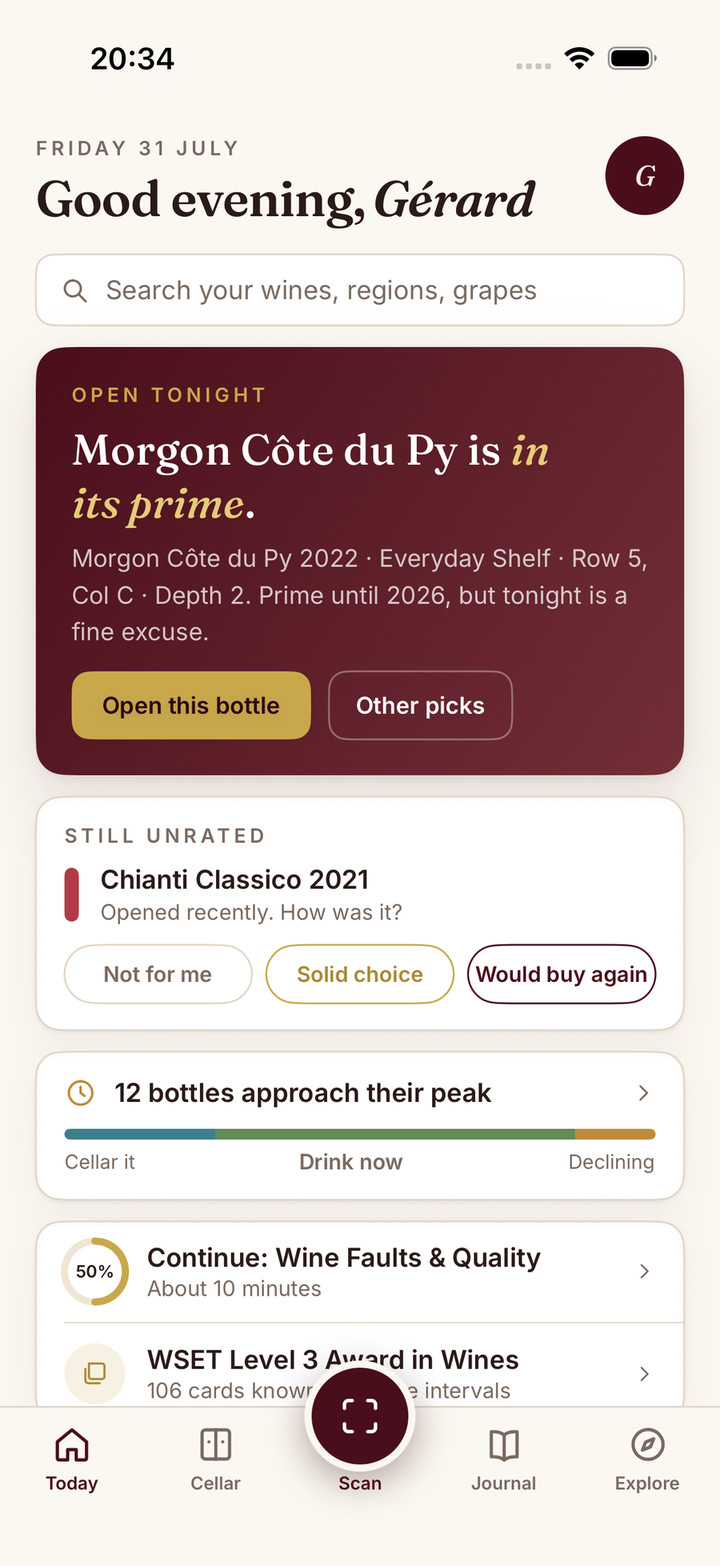
Sommo joins the lesson, the bottle and the review session. Beginners start with fundamentals and short modules. A label scan then turns an actual bottle into a region, grape, structure and pairing lesson. The tasting journal makes you observe appearance, nose, palate and conclusion rather than tapping a score and moving on.
Sommo is not a learning-only app. The same bottle can sit in a 3D cellar, be chosen for dinner, move into Taste DNA, join a Sharing Party or become a designed note you send to a friend. That wider wine life is what keeps the study grounded in bottles you actually buy and open.
For WSET Levels 1 to 4, the app adds spaced repetition, quizzes, mock exams, adaptive weak-topic sessions and typed-answer practice where appropriate. The official course material remains the source; Sommo is designed to make that source retrievable.
The advantage is continuity. A Riesling fact in a flashcard can become a bottle scan, a tasting note and a pairing decision in the same account. Learning stops feeling like a separate mode you open before an exam.
Best for: beginners, curious drinkers and WSET candidates who need practice rather than another pile of notes.
Not best for: awarding a formal qualification, deep trade reporting or a public library of professional articles.
The best WSET revision apps guide compares the exam-specific workflow in more detail.
2. GuildSomm: Best for Professional Depth
GuildSomm’s official education site offers member courses across regions and professional fundamentals, including service, wine law, viticulture, grapes and specialist regional topics. It is built for people who already know why those details matter in a restaurant or trade role.
The quality of depth is the draw. A learner can move beyond a simplified grape profile into producer context, regional change and the practical language used by sommeliers.
It is less suited to the absolute beginner who needs a visible first step and daily reinforcement. Membership value also depends on how often you use the wider professional library.
Best for: working sommeliers, advanced students and trade professionals.
Not best for: a gamified start, a personal tasting journal or an awarded general qualification.
3. Wine Scholar Guild: Best for Country Specialisation
Wine Scholar Guild is a course platform rather than a casual learning app. Its current path covers country-focused Essentials and Scholar programmes for France, Italy, Spain and Germany, with advanced regional study beyond them. Official materials include manuals, e-learning and specialist support, with delivery online or through course providers depending on the programme.
This is the best pick when the learner needs one country in serious depth and wants an examined credential from the specialist body. WSG itself describes the courses as complements to broad qualifications such as WSET, CMS and SWE.
Best for: buyers, educators, import teams and enthusiasts with a clear country focus.
Not best for: broad first-stage knowledge across the whole wine world.
Use the WSET alternatives guide to place country specialisation beside the other qualification paths.
The focused WSET versus Wine Scholar Guild comparison decides the sequence in more detail.
4. Quizlet: Best for Your Own Cards
Quizlet is not wine-specific, which is both the weakness and the value. You can turn the exact current specification, your provider notes and your personal errors into a small deck. That is often better than inheriting somebody else’s thousand-card system.
Shared decks are the risk. Wine laws, classifications and exam scopes change, while copied cards can flatten nuance into a confident error. Verify every imported card and delete anything you cannot source.
Best for: disciplined learners who want complete control of a compact deck.
Not best for: trusted wine content, bottle scanning, tasting feedback or an integrated curriculum.
5. Vivino: Best for Incidental Bottle Discovery
Vivino can teach around a moment of shopping. A scan brings up the wine, community notes, broad flavour patterns, food suggestions and related bottles. That makes unfamiliar labels less opaque and can create useful curiosity.
It is not a curriculum. Community descriptions vary in quality, crowd ratings reward popularity and the buying journey sits close to the information. Use it to ask questions of a bottle, not to decide what a serious learner must cover next.
Best for: casual discovery in the shop and seeing how many drinkers described the same wine.
Not best for: systematic theory, assessed tasting or verified WSET recall.
The Learning Loop That Actually Works
Pick one concept, one bottle and one retrieval task. Learn why cool climate raises acidity. Taste a relevant white. Record the acidity and fruit. The next day, explain the mechanism without looking.
That loop makes an app valuable. Passive minutes and badges are weak evidence if the fact disappears at the table.
Download Sommo to start with the free fundamentals, then keep the next bottle in the same app for the cellar, journal, palate and table.
What kind of wine learning do you need next?