What is the best wine app in 2026?
There is no single winner for every job. Vivino is strongest for crowd ratings, CellarTracker for inventory depth, Wine-Searcher for finding a bottle, and Sommo for connecting scanning, cellar, journal, pairings, personal insights, sharing and wine knowledge across iPhone, Android and the web.
The wine app you pick in 2026 says less about your phone than it used to. The real question is whether you want a specialist for one moment or a home for your whole wine life: the bottles you scan, own, open, remember, share and want to understand. That is a higher bar than a big database and a star rating.
I have spent this year testing the apps people actually reach for, on real bottles, across every platform I own. Here is how they rank, the criteria I used to get there, and an honest answer to the most searched question in the category: is there an Untappd for wine?
Choose the App by the Job
Start with the moment that keeps sending you back to your phone. A specialist can be the right answer when one job matters more than everything around it.
| Your main job | Start with | Why |
|---|---|---|
| Check crowd opinion before buying | Vivino | The largest public rating and shopping habit in the group |
| Organise a serious collection | CellarTracker | Deep inventory, valuations and collector history |
| Find a particular bottle or merchant | Wine-Searcher | Purpose-built price and availability search |
| Follow professional tasting notes | Delectable | A feed shaped around trade voices rather than crowd averages |
| Connect scanning, cellar, journal and learning | Sommo | One private record across the bottle’s whole journey |
If your immediate choice is narrower, the cellar app versus spreadsheet guide explains when software genuinely earns the switch. For tasting records, the wine journal app guide compares quick logs, structured notes and export.
The 5 picks at a glance
| App | Best at | Price | Platforms |
|---|---|---|---|
| Sommo | Your whole wine life in one connected app | Free tier; Premium at $5/month or $29.99/year | iPhone, iPad, Android, web |
| Vivino | Crowd ratings and price checks in the aisle | Free with ads; paid Premium tier | iOS, Android, web |
| CellarTracker | Cellar inventory, valuations, drink windows | Free tier; paid subscription | Web, iOS, Android |
| Wine-Searcher | Finding a specific bottle at the best price | Free; Pro subscription | Web, iOS, Android |
| Delectable | Following sommeliers and wine professionals | Free; paid subscription | iOS, Android |
Most wine lovers end up with two of these: one for shopping, one for remembering. The rest of this guide is why.
What makes a wine app worth keeping in 2026
The old checklist was database size and social feeds. The one that matters now is different:
- Runs everywhere, natively. One account that follows you from an iPhone at dinner to an Android tablet on the sofa, built for each platform rather than a website in a shell.
- AI that understands wine. Not a general chatbot bolted onto a scanner, but a model that knows structure, region, and food, and admits when it is unsure.
- Learns your palate, not the crowd’s. A 3.8 average tells you what strangers thought. A good app tells you what you will think.
- Connects the bottle’s whole life. The scan should be able to become a cellar position, dinner pairing, journal entry, palate signal or shared tasting without starting over.
- Honest, predictable pricing. A price you can read off the page, with no pressure to buy bottles you did not come for.
- Respects your data and attention. Clear privacy choices, usable export and no surprise loss of your own notes.
With that framework, here is the ranking.
1. Sommo: best all-round wine app
Full disclosure: Sommo is my app. Here is why it tops the list on the criteria above, and where it still trails.
Sommo is native on iPhone, iPad, and Android, with a web app alongside. The Android version is a true port, written the way the iOS app is written for iOS, so it is the whole app rather than a cut-down edition. Your journal, cellar, progress, and subscription sync across every device.
Underneath sits a wine-specific AI system grounded in structured wine data. The same intelligence supports scanning, pairing, tasting feedback and palate analysis, with explicit limits published on Under the Hood instead of pretending every answer is certain.
The app learns your palate. Your ratings and tasting notes build a Taste DNA profile and an AI character analysis, weighted so recent bottles count more than old ones. Your notes power your own profile only. They are never sold or used to train a model other people rely on.
What you get in one place:
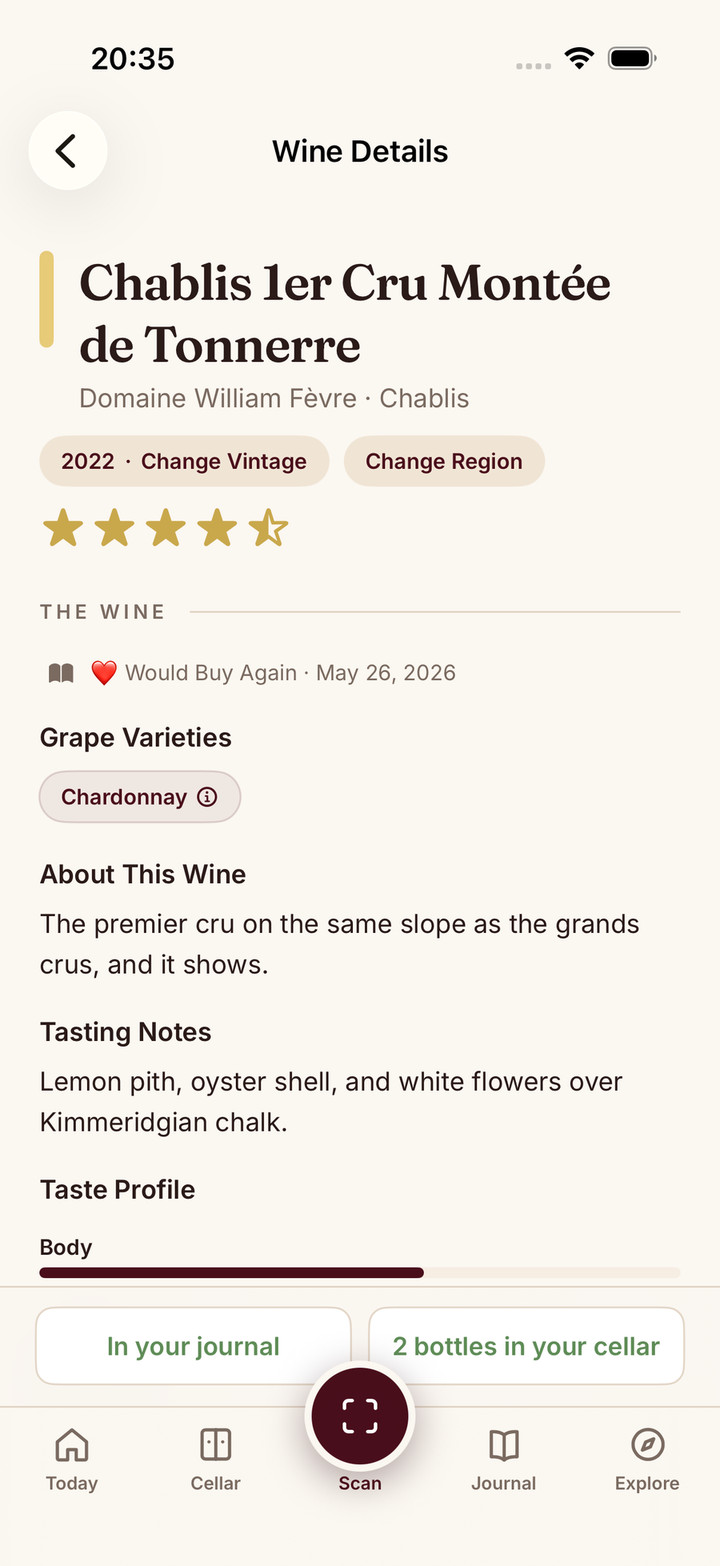
- AI label scanning with tasting profile, region, grapes, and a drinking window. See the scanning guide.
- A tasting journal with structured SAT notes and AI feedback on your palate.
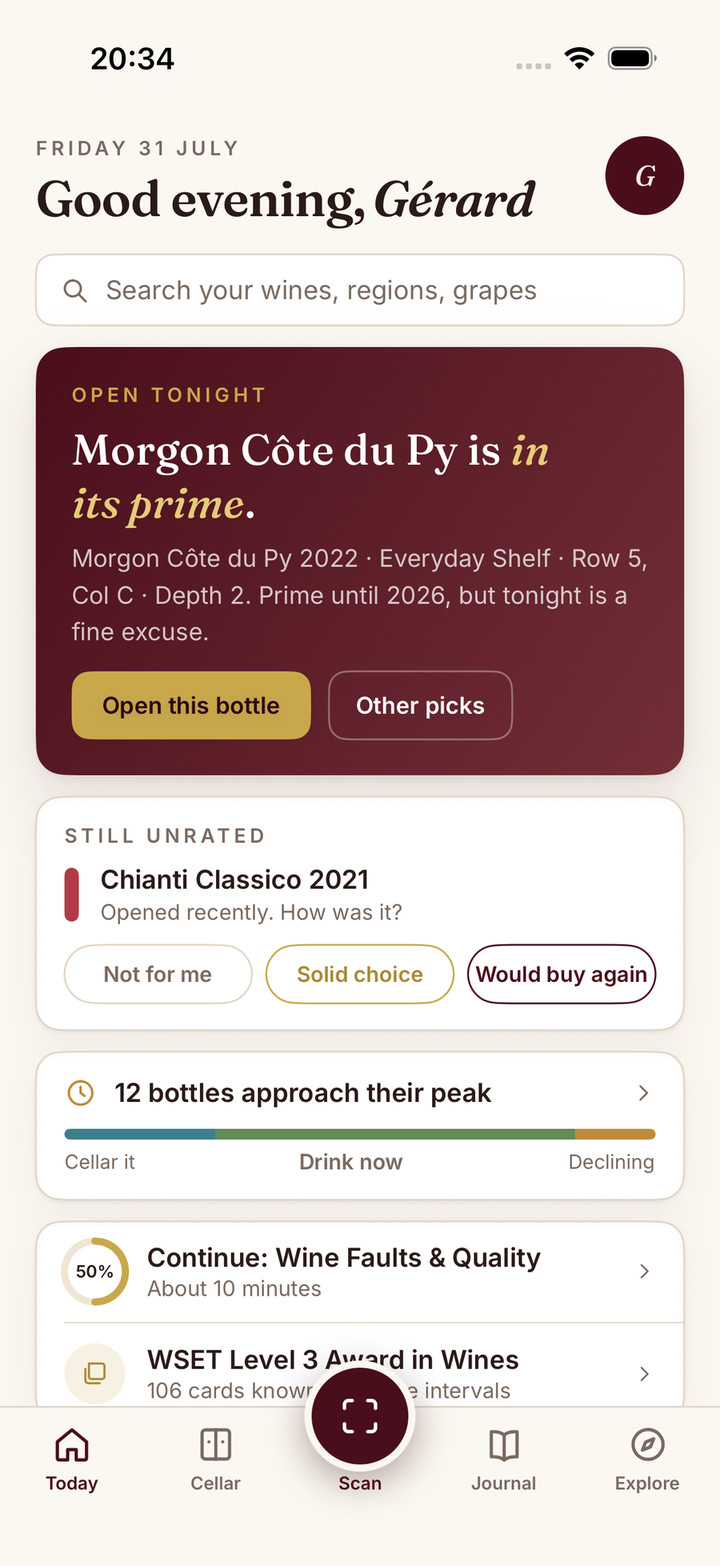
- A smart cellar with multi-rack inventory, drinking windows, AI food pairing from bottles you own, and an Open Tonight pick.
- Tasting mode for flights, with AI session insights and per-wine reviews.
- Sharing Party and Mix Palate for blind group tastings, palate comparisons, shared racks and designed share cards.
- Menu scoring that reads a restaurant list and flags the smart buys.
- An atlas of 1,000+ regions, and full WSET Level 1 to 4 prep with AI-graded typed answers.
- Ten languages, interface and AI writing alike.
Pricing is fixed and generous. The free tier is real: five lifetime scans, the fundamentals module, a 30-day journal, full map access, and WSET fundamentals. Premium is $5 a month or $29.99 a year, with a three-day trial and no card upfront. No ads on either tier. Apple Family Sharing and Google Play Family Library both cover up to five people.
Weaknesses, honestly: the community is smaller than Vivino’s because Sommo is newer, and it is private and invitation-led rather than a public rating feed. There is no bottle shop or merchant price comparison by design, so this is not the app for one-tap buying.
Verdict: if you want one beautifully designed app that scans, cellars, pairs, remembers, shares and grows with you on whatever device is in your hand, this is the one I built for exactly that.
2. Vivino: best for crowd ratings and buying
Vivino is the giant in this space, with over 60 million users and the largest crowd-sourced database anywhere. Point your camera at almost any label and it has been catalogued, rated, and priced.
Strengths: unmatched recognition on common bottles, community ratings from millions of users, price comparisons, and a built-in shop for buying then and there.
Weaknesses: the free tier is ad-supported, and the marketplace is central to the experience. Crowd scores flatten to an average that hides whether you will like a wine, while the fuller cellar, drinking-window and wine-list tools sit in Premium. It can feel overwhelming for beginners.
Price: free with ads; Vivino Premium removes them.
Verdict: the best tool for checking what the crowd thinks and buying on the spot. Just do not expect it to teach you much.
3. CellarTracker: best for serious, large cellars
CellarTracker has been around since 2003, and it shows in both its comprehensive features and its somewhat dated interface. With over 13 million tasting notes, it remains the reference for collectors, with inventory tools nothing else matches at scale. It also absorbed Delectable, adding professional sommelier reviews to the mix.
Strengths: exhaustive cellar management, market valuations for investment tracking, and detailed drink window recommendations for a large collection.
Weaknesses: the deepest workflows still have a learning curve, and collection management remains the centre of gravity. For a broader, all-in-one take on this category, see the cellar app comparison.
Price: free basic tier; subscription for the full feature set.
Verdict: essential if you have 50 or more bottles and care about their value. Overkill for everyone else.
4. Wine-Searcher: best for hunting a specific bottle
Wine-Searcher is not really a wine app, it is a price engine. If you know exactly what you want and need the best price or a rare bottle, nothing beats it.
Strengths: comprehensive merchant pricing worldwide, professional-grade information, and unrivalled for tracking down rarities.
Weaknesses: no scanning, no learning, no personalisation, and an interface built for search rather than discovery. Not beginner-friendly at all.
Price: free basic; Pro subscription for advanced data.
Verdict: a specialist tool for bargain hunters and collectors chasing specific labels.
5. Delectable: best for following professionals
Delectable takes a different approach: instead of crowd-sourced ratings, it emphasises reviews from verified sommeliers and wine professionals, which makes it a cleaner, more curated feed. It now sits under the same roof as CellarTracker.
Strengths: expert reviews you can actually trust, a clean modern interface, and good label scanning.
Weaknesses: a smaller database than Vivino, little structured learning, less useful for everyday wines, and premium features behind a paywall.
Price: free with a premium option.
Verdict: worth it if you want to follow the trade and discover higher-end bottles.
If you are on iPhone
Your hardware gives you advantages most wine apps barely use.
Camera quality. Label scanning is only as good as the image it receives. Computational photography on recent iPhones, especially in low light at a restaurant, makes a real difference in recognition speed and accuracy.
Notifications and widgets. A wine record works only if it stays easy to maintain. Notification scheduling, Focus modes and home-screen widgets let the right apps surface bottles approaching their window or make a tasting easy to log.
Ecosystem integration. Apple Watch reminders, Handoff between iPhone and iPad for reviewing notes on a larger screen, and tight privacy controls all matter when choosing a wine app.
Whichever app you pick, judge it on five iOS-specific tests: native performance, camera integration under restaurant light, continuity from scan to cellar and journal, the App Store privacy labels, and offline access for reviewing notes in a cellar. Sommo is built natively for iOS while keeping the same account and feature set on Android and the web.
Is there an Untappd for wine?
This is one of the most searched questions in the category. Untappd is a beer app: you check in a beer, rate it, earn badges, and see what friends are drinking. There is no wine edition of it.
The dedicated Untappd for wine comparison maps the check-in, social-feed, badge and collection behaviours app by app. The short answer here is still useful; that guide is for choosing which part of the habit you actually want.
What people are asking for is the habit rather than the brand. Scan a bottle, log it in a few taps, build a history you can scroll back through, and see what others thought. Three apps here cover parts of that.
- For the check in and the crowd, Vivino is the closest match. Scan a label, get a community rating, log the bottle, follow friends. The social layer is the largest in wine.
- For a feed worth following, Delectable leans toward sommeliers and industry professionals rather than the general public, which makes ratings feel more curated and the volume much lower.
- For the logging habit plus a connected wine life, Sommo is closest in spirit: scanning, a personal journal, cellar, XP and badges, Sharing Parties, Mix Palate and shared racks. It is private first rather than a public ratings network.
One honest caveat: wine is harder to check in than beer. A beer label is one product, while a wine label is a producer, a cuvée, and a vintage. Every app here, Sommo included, occasionally misreads one.
So which app should you download?
If the free tier is the deciding factor, the best free wine rating apps compares exactly what Vivino, CellarTracker, Wine-Searcher, Delectable and Sommo let you do before payment, including privacy and rating limits.
- Download Vivino if you mostly want crowd ratings and to buy while you shop, and you do not mind ads.
- Download CellarTracker if you have a large collection and need serious inventory and valuations.
- Download Wine-Searcher if you are hunting a specific bottle at the best price.
- Download Delectable if you want to follow sommeliers and discover premium wines.
- Download Sommo if you want one independent app for the bottles you scan, cellar, pair, journal, share and explore, without an ad wall or a nudge to buy.
Using two apps for different jobs is a perfectly sensible outcome. For deeper one-on-one comparisons, see the alternatives section: Vivino, CellarTracker, Delectable, and Wine-Searcher. If scanning is the feature you care about most, the best wine scanner apps compares that job on its own, and if you are studying for a WSET certification, structured learning matters more than database size.
Not sure where your palate stands before you commit to any of them? The free wine quiz takes two minutes and needs no download at all.
Explore with Sommo
Sommo turns a bottle into a cellar position, a pairing, a memory, a shared table and a smarter next pour on iPhone, iPad, Android and the web. It is independently built, free to start, and has no ads, bottle shop or data selling. Read why users have a seat at the roadmap or see the wine-tuned AI refined every week.
Download Sommo free and scan your first bottle tonight, or read more about how the AI stays honest.
If the record matters more than the scanner, the best wine journal apps compares structured tasting, quick logs, collector history and export.
If the next decision matters more than the wider toolkit, the best wine recommendation apps separates shopping, menu, pairing and cellar advice.
Which should you pick tonight?