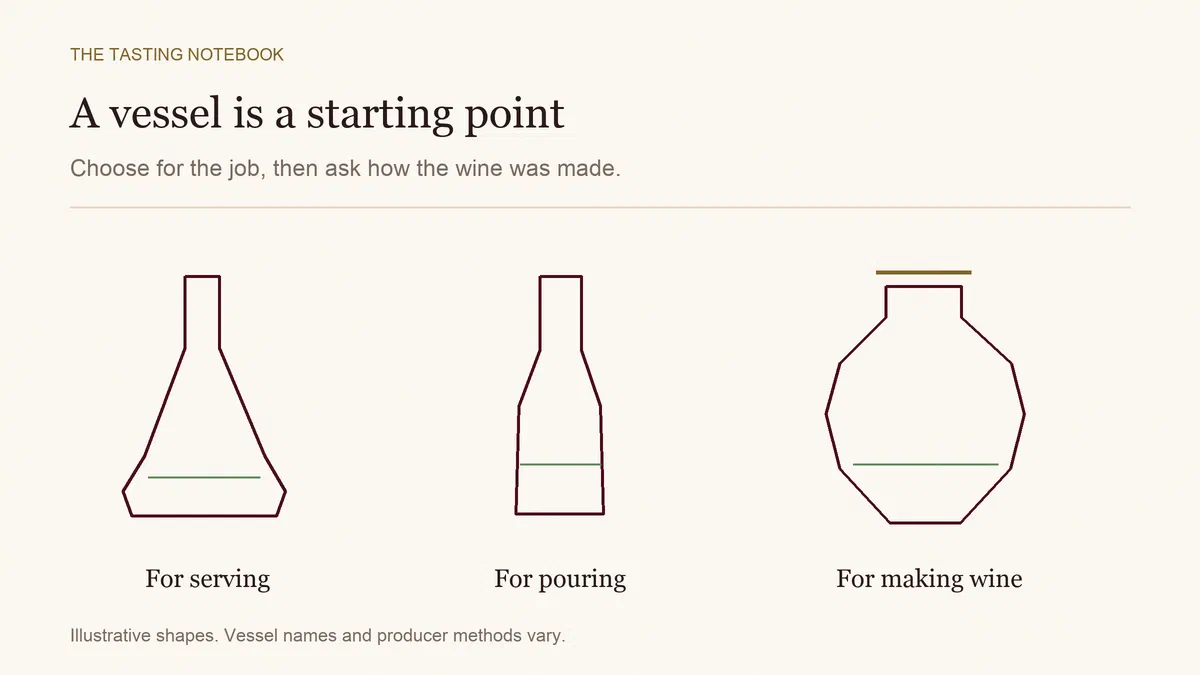
Amphora wine tells you that a clay vessel was used in production; it does not give you one colour, flavour or complete winemaking recipe. Ask whether the vessel was used for fermentation, ageing or both, whether it was lined, and how the grapes or wine were handled inside it.
Qvevri wine is an important Georgian tradition, covered in our Georgian wine guide. But clay vessels also appear in Portugal, Italy, California and elsewhere. Treating every amphora bottle as Georgian orange wine misses both the geography and the method.
Separate the vessel from skin contact
An orange or amber wine gains its character from white grapes remaining in contact with their skins. That is a production choice, not a requirement imposed by clay. A white wine can enter an amphora after pressing; red grapes can also be fermented in one.
Our skin-contact guide explains that process. When reading “amphora” on a label, look for the separate explanation of skins, lees and time. If it is not provided, leave that part of the method unknown.
Three producer examples that break the shorthand
The following official producer descriptions were checked on 10 October 2026. They are examples of particular wines and releases, not rules for every clay vessel.
| Wine and place | What the producer describes | What you can reasonably record |
|---|---|---|
| Thibido First Date Grenache Blanc, California | The 2020 wine entered clay after pressing, remained on lees and was bottled in March 2021 | White wine; post-press clay use and lees contact, rather than an assumed skin fermentation |
| Esporão Vinho de Talha White 2024, Alentejo | Fermentation in pine-resin-lined talhas, with grape-marc contact | White grapes; stated lining and skin/material contact |
| Esporão Vinho de Talha Red 2023, Alentejo | Partial destemming and fermentation in lined amphorae | Red wine; clay is not an orange-wine category |
See Thibido’s account of First Date, Esporão’s white technical page and its red technical page. Read the sheet for the release in your hand, because a producer can change its method between wines or years.
These examples do not establish a universal oxygen-transfer rate, temperature effect or absence of added sulphites. Nor does clay certify organic or biodynamic farming. Those are separate claims that need their own evidence.
Four questions that reveal more than the vessel name
At what stage was clay used? Fermenting grapes in clay is different from ageing an already fermented wine there. A wine may also move through other vessels. “Amphora-aged” does not describe its entire route from grapes to bottle.
What was in contact with the wine? Skins, stems and lees are different materials. A description of lees ageing after pressing should not become a note about months of skin maceration.
Was the inside lined? The Esporão examples show that a clay vessel need not have bare clay in contact with the wine. Copy a stated lining; do not assume every amphora is waxed, resin-lined or unlined.
How much of the wine used it? If only part of a blend went through clay, that matters. Ask whether the producer gives a proportion or describes the whole wine. Leave it unspecified when the source does.
This approach also avoids an overly tidy history. Regional vessel names and traditions carry their own context; they are not interchangeable labels for one standard tank.
Taste the bottle without tasting the marketing first
Clay is often associated with words such as purity, earthiness or texture. They can be a producer’s description of its own wine, but they should not become your expected result for every amphora bottle.
For a first taste, identify fruit, acidity, body and any grip before trying to explain them through the vessel. A pressed Grenache Blanc and a skin-contact white can differ greatly even though both encountered clay. Grapes, site, skin handling, lees, other vessels and serving conditions can all contribute.
If you compare two wines, choose a question you can actually answer: “Which texture did I prefer?” is fair. “Clay caused the difference” requires a comparison that controls far more than two labels saying amphora.
A compact method-and-taste note
Use two separate lines in your tasting journal:
- Method: producer and exact wine; release; clay used at the stated stage; lining and contact details; source link; unknowns.
- Taste: date and serving conditions; fruit, structure and finish you noticed; whether you would choose it again.
An illustrative entry might say: “Producer sheet describes clay ageing after pressing; skin contact not stated. At dinner I noticed fresh fruit and a broad texture.” The first sentence is sourced method; the second is your observation. Neither requires an invented clay flavour.
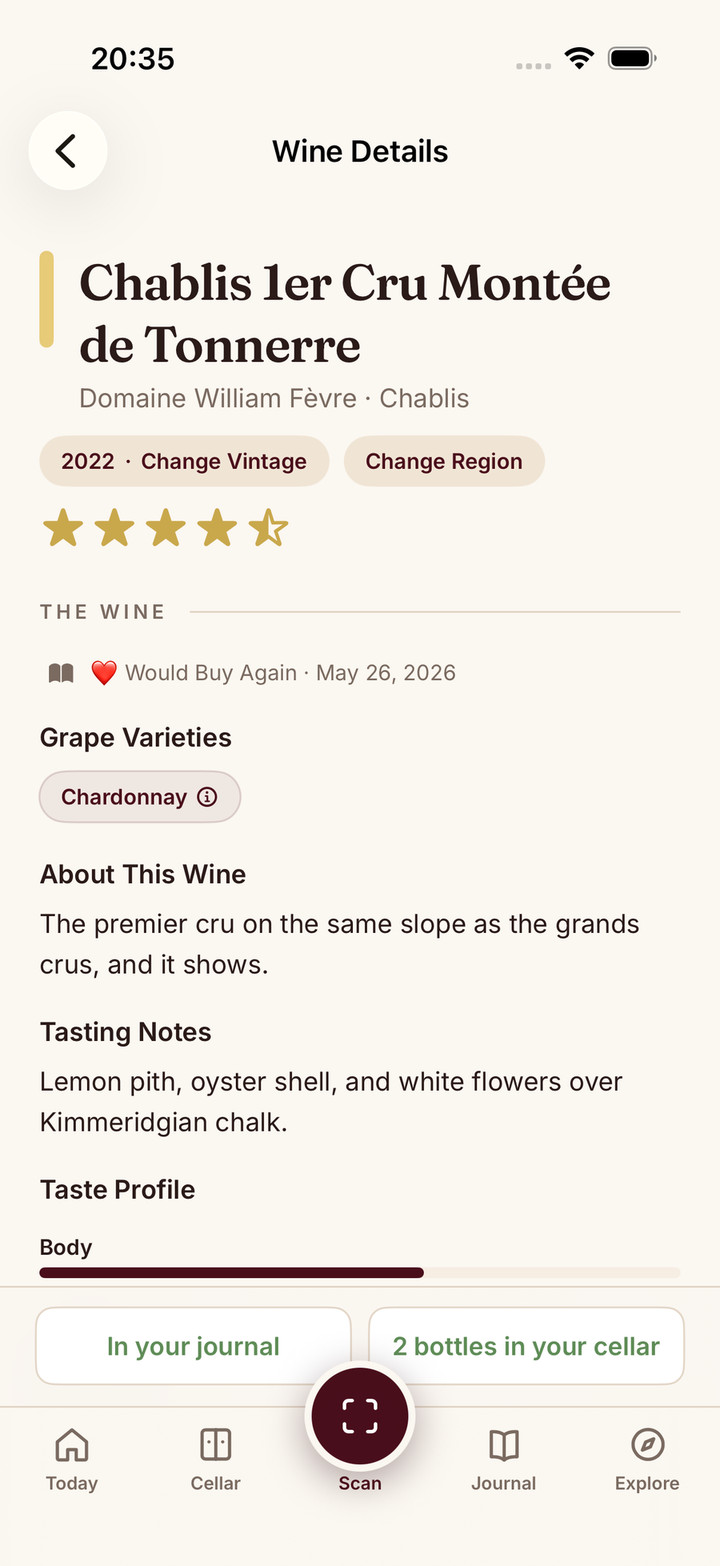
Save the actual wine and your own reaction in Sommo. Free journal history covers the last 30 days; Premium gives access to the full history. Keep the producer reference with the note so the vessel becomes a useful detail about a bottle, rather than a substitute for tasting it.