The question lands in our inbox every week. Can an AI app really replace a sommelier? Will a phone take the job of the person standing at your table with a wine list and a knowing smile? The short answer is no, but the more interesting answer is that the question is poorly framed. AI and sommeliers are not competing for the same job. They are doing different versions of the same craft, with different strengths, different blind spots, and different costs. The wine drinker who understands both gets more out of wine than the one who relies only on one or the other.
This is the honest breakdown. Where AI wine apps are now genuinely better than human sommeliers. Where humans remain irreplaceable. And how the two work together for the wine drinker in 2026.
What a Human Sommelier Actually Does
To assess what AI can replace, it helps to understand what a sommelier really brings to the table. The job is more nuanced than most people realise.
A sommelier (the credentialed wine professional, typically in a restaurant) does several things at once. They build a wine list that suits the restaurant’s food, location, price ceiling, and clientele. They store and serve wine correctly. They read a table within the first 30 seconds of conversation, identifying the person who knows wine, the person who is pretending, the budget envelope, and the food likely to be ordered. They suggest pairings that surprise without confusing. They open, decant, and pour. And they manage the emotional weight of the experience, making the customer feel knowledgeable without being lectured at.
That is a lot of human skill, and most of it has nothing to do with information retrieval. The pairing knowledge is necessary but not sufficient. The interpersonal layer is where the value compounds.
Where AI Wine Apps Are Already Better
Setting interpersonal skills aside, there are several specific things that modern AI wine apps now do better than the majority of human wine professionals. This is not marketing copy. These are concrete, testable advantages.
1. Instant Identification of Any Bottle
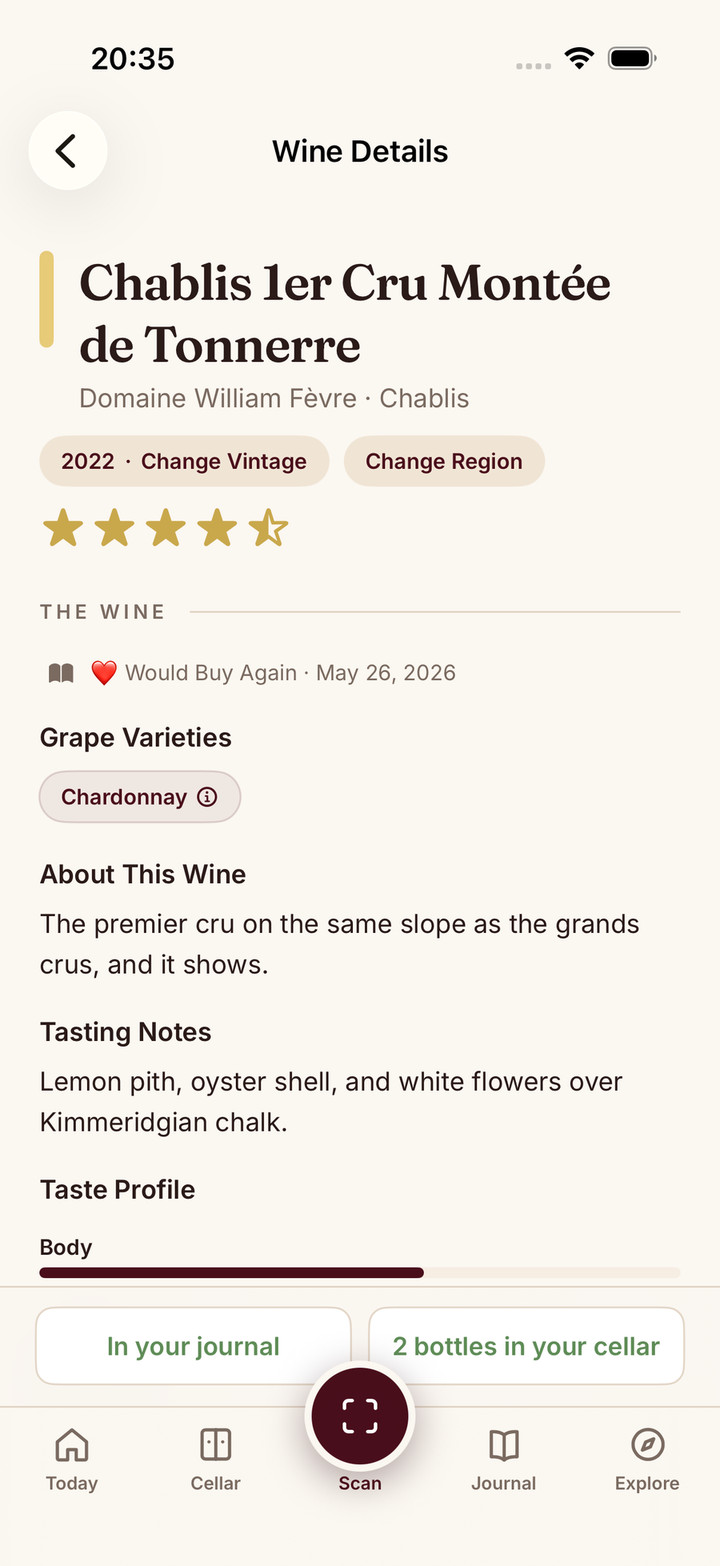
Point a phone at a label and an AI tool can identify the wine, retrieve its producer, region, grape, vintage, drinking window, official tasting notes, and rough price range in two to three seconds. A sommelier can do this for bottles they recognise, which usually means well-known producers and famous regions. For an obscure grower Champagne, a small Portuguese producer, or a single-vineyard Etna Rosso from a producer with limited distribution, the average sommelier is googling on their phone like the rest of us.
Apps like Sommo handle this case automatically. The AI label scanner works on bottles from any region, any producer, any vintage, in any language. For more on how this works, see our AI wine label scanning guide.
2. Total Recall of Your Personal History
The single biggest advantage AI has over a human sommelier is memory. Even your favourite sommelier at your favourite restaurant remembers maybe ten things about your wine preferences, and only when you visit regularly. An AI wine journal remembers every wine you have ever scanned, rated, and noted. It can tell you that you have rated 12 different Pinot Noirs, that your average rating is higher for cool-climate examples, that you scored two specific producers consistently above 4.5, and that the wines you disliked all had high alcohol levels. No human can hold that level of detail across a year of drinking.
This personal pattern recognition is what lets AI recommendations beat generic critic scores. A 90-point wine in a magazine is averaged across a panel of strangers. A wine that matches your specific preference cluster, drawn from your own data, is meaningfully more useful.
3. Restaurant Wine List Scoring
If you are sitting in a restaurant and want a second opinion on the wine list, AI is now genuinely superior to most servers. A photo of the wine list returns scored recommendations in seconds, ranked by how well each option matches your preferences, your meal, and your budget. The AI knows the producers on the list, even the obscure ones, and can flag the genuine values that the restaurant has marked up modestly versus the well-known names where the markup is heavy.
A great sommelier still wins here when they are present and engaged. A typical server in a mid-tier restaurant is at a real disadvantage compared to a phone. See our restaurant wine menu scoring guide for a full walkthrough.
4. Cellar and Drinking-Window Management
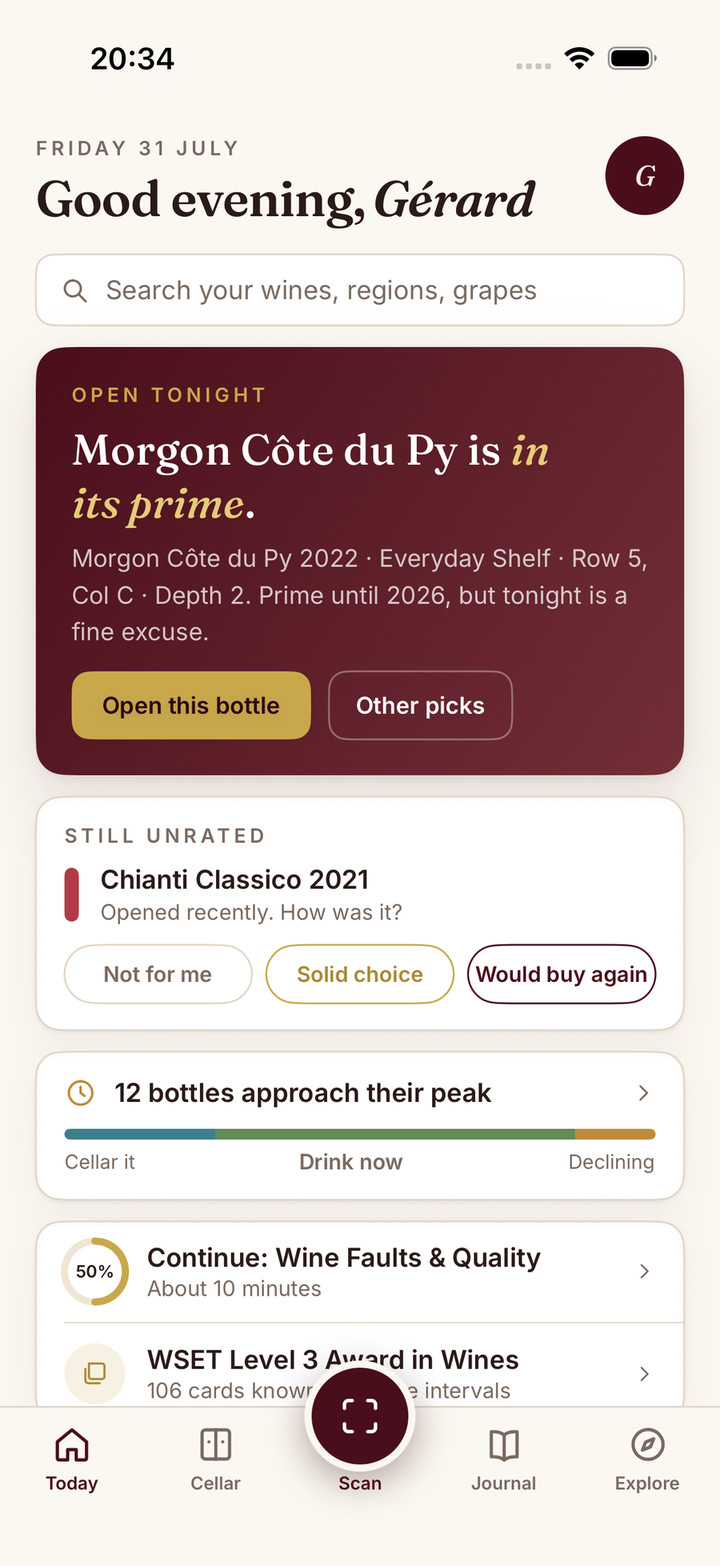
Knowing when to drink each bottle in a personal cellar is genuinely difficult. Wines develop on individual timelines based on grape, region, vintage, and storage conditions. An AI cellar manager tracks every bottle you own, models its drinking window, and tells you what is ready now, what is approaching peak, and what is past prime. It can also push notifications when a bottle is entering its window so you do not miss the moment. Sommo documents how drinking windows are estimated on Under the Hood.
No human can do this at scale unless they are a full-time wine professional managing your cellar for you, which is expensive and rare.
5. Education That Adapts to You
If you want to learn wine, an AI tutor adapts to your level in real time. It knows what you have already studied, what you understand, where you struggle, and what to teach next. Adaptive practice with spaced repetition, like the system used in Sommo’s WSET prep, produces better learning outcomes than the average classroom, and at a fraction of the cost. For more, see our guide on how to study for WSET using spaced repetition.
A great human teacher can match this for one student. But great wine teachers are rare and expensive, and they cannot scale.
Where Human Sommeliers Are Still Irreplaceable
The list above is real, but it is not the whole story. There are specific areas where a human sommelier delivers value that no AI can currently match, and probably never will.
1. Reading the Room
A sommelier at the table for two minutes knows things no app will ever know. They see the body language, the way you are holding the menu, the way your partner is glancing at the prices, the moment of slight hesitation when you order the second cheapest red. They calibrate the recommendation to all of that in real time. They make the decision feel like yours, even when it was theirs.
This is a craft skill that took them years to learn. It is also fundamentally about humans reading humans. AI does not currently do this, and the next few generations of AI are unlikely to. Even if they could, most diners do not want to be read by a machine the way they want to be read by a person.
2. Sensory Confirmation
A sommelier opens the bottle, smells the cork, tastes a small pour, and decides whether the wine is sound. AI cannot do this. A bottle that is corked, oxidised, or otherwise faulty looks identical to a sound bottle on the outside. The verdict happens at the moment of opening.
This skill matters more often than people realise. Roughly 3 to 5 percent of wines under natural cork are noticeably affected by TCA (cork taint), and far more wines suffer from subtle storage issues that are not obvious to a casual drinker. A good sommelier catches these. The diner gets a clean bottle. AI cannot replace this part of the job, full stop.
3. Service and Storytelling
Pouring wine well is not a trivial skill. Decanting at the table without sloshing, knowing when to top up a glass and when to leave it alone, narrating a wine with one or two sentences that make the bottle feel chosen specifically for the table: these are theatre. They are part of why fine dining costs what it costs.
The story of a wine (where it came from, who made it, why it tastes the way it does) is also a deeply human pleasure. AI can deliver the facts, but a sommelier who has visited the estate, met the winemaker, and tasted the wine across vintages tells the story in a way no app will replicate.
4. Risk-Taking Recommendations
This is the subtle one. A great sommelier sometimes recommends a wine that does not perfectly fit your profile, because they think you will love it once you try it. They take the risk. They pour you something you would not have ordered, and they earn your trust over a year of meals because their bets pay off more often than not.
AI is trained to minimise risk. By definition, AI recommendations cluster toward the high-confidence centre of your preference profile. They are reliable but rarely surprising. The genuinely transformative wine experience, the one that opens a new door in your palate, almost always comes from a human who knew you well enough to push you.
The Pricing Reality
There is one more difference worth being clear about. A sommelier at a fine dining restaurant is part of a cost structure that you are paying for, whether you talk to them or not. A typical wine list markup in a serious restaurant is 200 to 400 percent over wholesale. That covers the wine, the staffing, the storage, the glassware breakage, and the expertise. It is an honest cost, but it is a real one.
An AI wine app costs nothing or a few dollars a month. For the wine drinker buying wine at retail, drinking at home, or trying to navigate a casual restaurant where the staff cannot pair, AI is now a remarkable democratising force. The person who could never afford to dine at a restaurant with a great sommelier can now have something close to a sommelier’s knowledge in their pocket for the price of a cheap bottle.
This is the part of the AI-versus-sommelier story that gets understated. AI does not replace the sommelier in the great restaurant. It brings sommelier-level guidance to the millions of wine drinkers who never set foot in those restaurants.
How the Two Work Together
The smartest wine drinkers in 2026 use both. Here is how the workflow looks in practice.
At home, planning a dinner. Open the AI app. Browse cellar inventory, see what is ready to drink, get pairing suggestions for the meal. Decide on the wine. No sommelier needed.
At the supermarket or wine shop. Scan unfamiliar bottles. Get an instant verdict tailored to your preferences. Skip the marketing creations, pick the genuine values. The shop clerk’s knowledge is usually irrelevant.
At a casual restaurant. Photograph the wine list. Get a ranked recommendation. Order with confidence. The server’s role is service, not curation.
At a fine dining restaurant. Engage the sommelier. Ask questions. Let them lead. The phone goes away. This is the moment human craft justifies its cost.
While learning. Use AI for daily practice, structured study, and adaptive review. Spend in-person money on classes with great teachers when you can, on tasting events with serious producers, and on dinners with sommeliers who will pour you something unexpected.
The two are complementary, not substitutes. The drinker who treats them as either-or will get less out of wine than the one who uses both.
What This Means for the Future of Wine
A few predictions, made cautiously.
Sommelier jobs at the top of the market will not disappear. If anything, they will become more valuable, because the parts of the role that AI cannot do (reading the room, sensory confirmation, storytelling) are the parts that justify the cost of fine dining in the first place. Customers paying top dollar for a meal will continue to want, and pay for, the human.
Mid-market sommelier jobs will compress. Restaurants that employ a sommelier mostly to recite the wine list and recommend safe pairings will increasingly let the server do it with an AI tool. The differentiator becomes the kind of curation, opening theatre, and customer relationship that only an experienced human delivers.
Home wine drinkers will become more confident. AI lowers the cost of expertise, which lowers the cost of trying new things. The historical wine knowledge gap between the dedicated enthusiast and the casual buyer will shrink. Wine becomes less intimidating for more people.
Sommeliers and AI will increasingly collaborate. The best wine professionals are already using AI tools to manage cellars, recall obscure producers, and provide customers with detailed follow-up information. The role evolves. It does not disappear.
Explore with Sommo
Sommo is built around the principles in this article. The AI does what AI is good at: instant identification, personal pattern recognition, structured tasting, cellar management and optional WSET study. Around that intelligence is the rest of wine life in one app: the journal, 3D cellar, pairings, drinking windows, private tasting groups, live shared racks and designed share cards. The app does not pretend to read the room or open your bottle for you. It complements the human professionals you will still want at the most important meals of your life.
Download Sommo free and give every bottle one connected home. The human sommeliers will still be there when you need them.